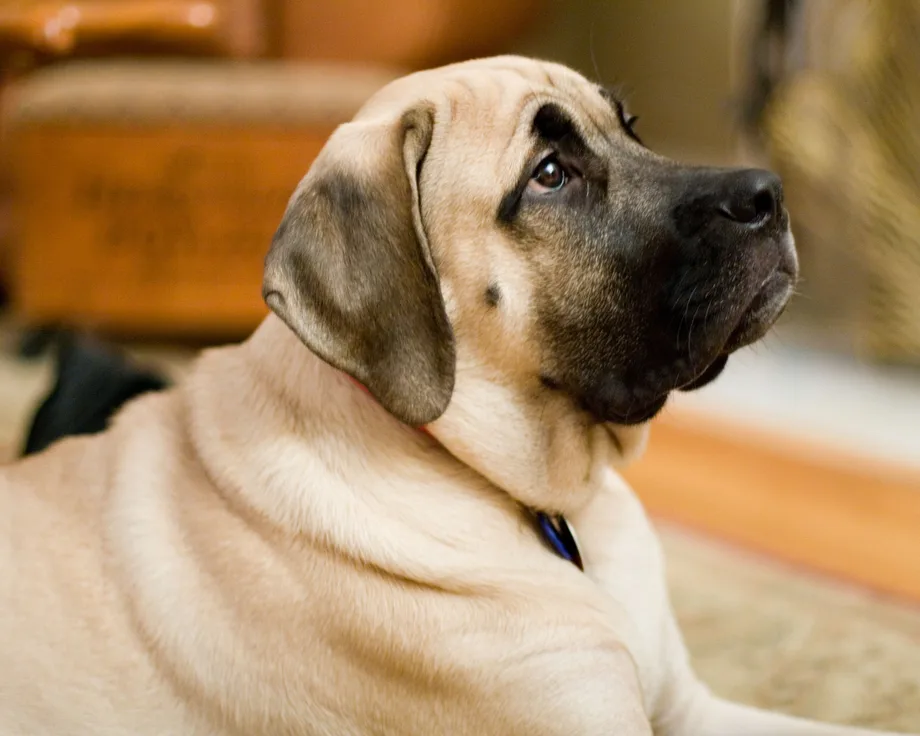
A menu for every age
Their needs change as they grow
Puppy: Growth must be slow and controlled with a large-breed food in order to limit stress on bones and joints.
Adult: The ration must support muscle mass without excess calories, ideally in 2 well-spaced daily meals.
Senior: A more digestible and moderately energy-dense food helps preserve mobility and avoid overweight.
Which food?
Kibble, wet food, or homemade meals?
Premium kibble formulated for large or very large breeds suits the Mastiff well, with a digestible composition, a quality protein intake and a rigorous mineral balance. For the puppy, a specific large-breed growth formula is preferable to support bone development gently.
Portion sizes
How much should you feed?
Quantities vary greatly depending on age, sex, weight and activity. In this giant dog, it is preferable to think in terms of an individualized ration and to split meals in order to limit digestive discomfort.
| Weight | Daily amount | Meals per day |
|---|---|---|
| 60 - 77 kg | 870 - 1173 g | 2 |
| 77 - 93 kg | 1070 - 1440 g | 2 |
| 93 - 110 kg | 1270 - 1706 g | 2 |
Changing food
How to switch foods successfully
Any dietary transition must be gradual over about a week, by mixing the old and the new food in stages. A change that is too abrupt exposes the Mastiff more to digestive disorders.
Hydration
Don't overlook water
Clean, fresh water must remain accessible at all times. After meals, it is advisable to let the dog rest and avoid exertion to reduce the risk of gastric dilatation-volvulus.
A little extra
Treats in moderation
Treats should remain occasional and be included in the daily ration. It is better to favor small, simple rewards rather than extras that are too fatty or too numerous, especially in a dog with little stamina and easily weighed down.
Good habits
Make mealtimes count
- Split the daily ration into at least 2 meals.
- Avoid exercise before and after meals.
- Regularly monitor body condition and adjust the ration.
- Choose a diet formulated for giant dogs.
Never feed these foods
As with other dogs, chocolate, onion, garlic, grapes, cooked bones, alcohol, xylitol and very fatty foods should be avoided. These substances can cause severe digestive disorders, poisoning, or worsen the risk of pancreatitis and digestive accidents.