Origins
Where does it come from?
The origins of the Broholmer date back to the Middle Ages, when its ancestors were notably used for deer hunting. It is said to descend from dogs brought back to Denmark by the Vikings, then crossed with mastiff-type dogs from Germany. After its use in hunting, it distinguished itself as a guardian of large estates and manors. The structured selection of the breed began at the end of the 18th century under the impetus of Count Sehested of Broholm, to whom it owes its name. Almost disappeared after the Second World War, the Broholmer was rebuilt from the mid-1970s with the support of the Danish Kennel Club. The FCI definitively recognized it on 26 May 1982 under number 315, and its current official standard was published on 26 June 2000. The breed is also recognized by the AKC and the UKC.
Appearance
What does it look like?
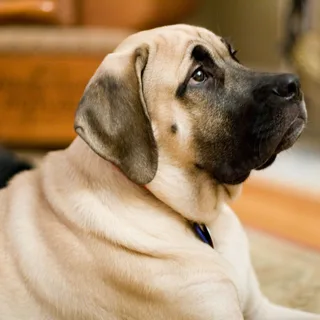
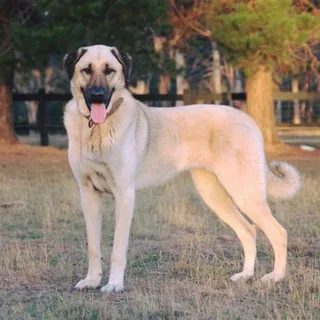
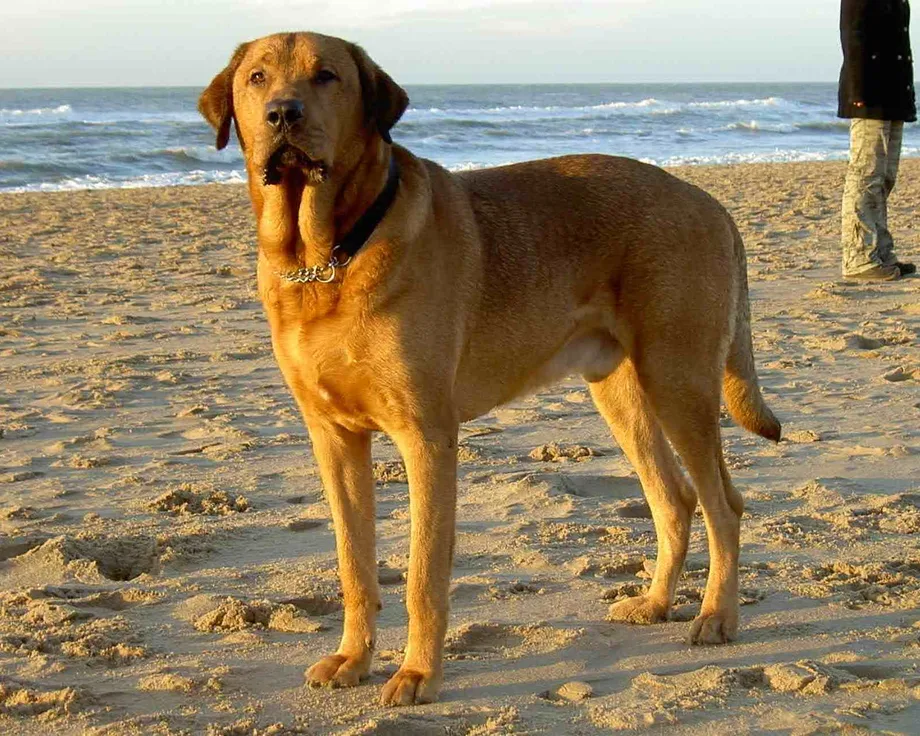
The Broholmer is a giant mastiff, massive and strongly built, whose rectangular silhouette combines power and elegance. Its body, longer than tall, has a powerful neck, a straight topline, a marked withers, a rather long back, a moderately sloping croup and a deep chest. Its triangular head is massive, broad and heavy, with a rather flat skull, a powerful muzzle, a large black nose and jaws articulated in a scissor or pincer bite. Its ears, medium-sized and set high, hang against the cheeks. Its round eyes, medium in size, range from light amber to dark amber. Its thick tail, set fairly low, is carried hanging at rest and raised to the horizontal in action. Its short, close-lying coat is doubled with a thick undercoat. The coat can be fawn with a black mask, red, golden or black, with or without white markings on the chest and feet.
Temperament
Temperament and personality
The Broholmer has a balanced temperament. Calm and friendly with its family, it is affectionate, devoted, self-confident and courageous. Its natural wariness toward strangers and its protective instinct make it a vigilant guardian, without erasing its qualities as a companion. Its socialization must be carefully handled, notably with other animals.
Living together
Living with children and other pets
On a daily basis, the Broholmer seeks closeness to its family while needing space and freedom of movement. It enjoys long walks and outdoor games, but overly intense exertion must be avoided in order to protect its joints. It is not suited to apartment living. The countryside suits it particularly well, even if it can live in the city provided it benefits from long and regular outings.
Training
Training and socialization
Its adult size requires early, consistent, high-quality training. Firmness must always be accompanied by gentleness, without brutality. Learning boundaries, leash walking, recall and handling is a priority, as is gradual socialization to people, dogs and varied environments.
Budget
Price and budget for the Broholmer
The purchase price varies notably depending on the quality of the selection, the parents' health screenings, conformity to the standard, the lineage and the guarantees provided by the breeder.
See cost breakdownHealth
Health at a glance
The Broholmer is a robust dog whose overall health is rather solid. Like other giant dogs, it nevertheless requires careful orthopedic monitoring and preventive measures against gastric dilatation-volvulus.
Prevention and things to watch forNutrition
Feeding your pet well
Its diet must be of high quality, complete and suited to its very large size, its age and its level of exercise. Particular attention is necessary during growth in order to support steady development without excess energy.
Our feeding adviceDid you know?
Fun facts and popularity
The name of the breed comes from the Broholm estate and from Count Sehested of Broholm, who played a major role in its selection at the end of the 18th century. The Broholmer is also known as the Danish Mastiff. After coming close to extinction following the Second World War, it was the subject of a reconstruction program in Denmark for several decades.