Origins
Where does it come from?
The Kangal is the livestock guardian dog of the Sivas region, in Anatolia. Selected by Turkish breeders to deter wolves and predators, it has developed a calm temperament, great autonomy and a massive but agile morphology. In Turkey, it is a national heritage, distinct from the more variable Anatolian Shepherd. In Europe, it is bred as a guardian of property and livestock, sometimes as a dog for an experienced family. It must not be confused with fighting molossers.
Appearance
What does it look like?
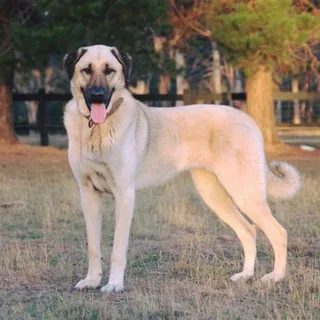
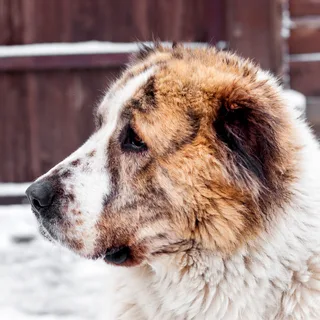
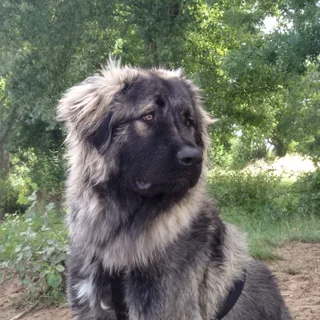
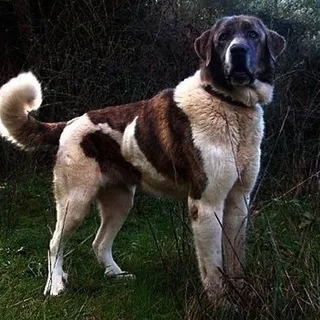
It is a giant, powerful and rectangular dog, with a supple appearance despite its mass. The head is broad, the muzzle slightly shorter than the skull, the characteristic black mask. The ears are drooping, the tail long and slightly curved. The coat is short to medium-long, fawn to sandy grey, with a dense undercoat. Females are clearly less heavy than males.
Temperament
Temperament and personality
Calm, confident and very territorial, the Kangal often decides for himself. He becomes attached to his family but is not a dog for constant contact. With the children of the household, he can be protective if he was raised with them; he is not an automatic nanny. Strangers are assessed from a distance. Broad socialization is essential.
Living together
Living with children and other pets
He needs space, a clear territory and outings, but not an intensive daily jog. Apartment living is unsuitable for him. He patrols, observes and barks to signal. A fenced, high and solid garden is a minimum. Boredom plus isolation produce an uncontrollable guard.
Training
Training and socialization
Training starts very early and aims at control, recall, inhibition and getting used to visitors. Calm firmness is better than confrontation. A poorly socialized Kangal becomes a safety problem. Bite sports are not recommended: its function is deterrence, not trained attack.
Budget
Price and budget for the Kangal
A companion or working Kangal from a well-monitored breeding program is often between 1 000 and 2 000 euros. The real cost is that of space, fencing and suitable insurance.
See cost breakdownHealth
Health at a glance
A rustic breed, the Kangal mainly suffers from the ailments of very large dogs: growth, stomach, joints. A diet adapted to the giant-breed puppy and measured exercise up to 18-24 months are essential. Serious breeding avoids subjects that are too heavy and too soft.
Prevention and things to watch forNutrition
Feeding your pet well
The Kangal needs a complete, digestible diet adjusted to its age, activity and body condition. Protein quality and control of energy intake matter as much as the volume of the ration.
Our feeding adviceDid you know?
Fun facts and popularity
In Turkey, the Kangal is a regional emblem, featured on statues and local festivals. Its black mask and fawn coat distinguish it at first glance. Some individuals still wear spiked collars inherited from protection against wolves.