Origins
Where does it come from?
The presence of short-tailed cats in Japan is ancient. Felines from China are reported in the archipelago as early as the VIth century and, in the Xth century, the emperor had manuscripts protected against rodents thanks to cats. Short-tailed individuals, particularly appreciated in Japan, have gradually acquired an emblematic place. The Western world discovers the breed more in the middle of the XXth century. In 1968, the American breeder Elizabeth Freret imports to the United States three individuals, then other cats bearing the same curled tail. The breed is recognized in 1976 by a major American feline association.
Appearance
What does it look like?
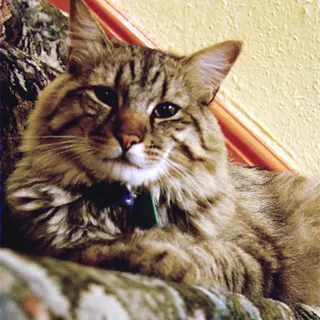
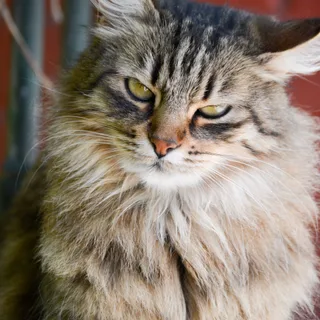
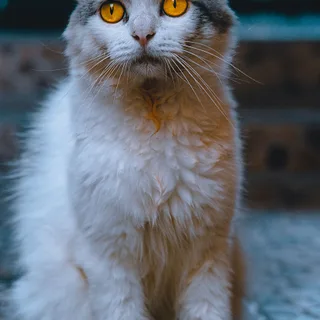
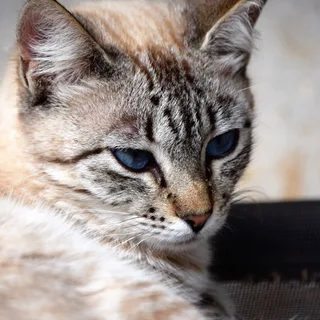
The Japanese Bobtail is a semi-foreign type cat, medium-sized, slender, long and elegant, with a straight back and small, oval feet. Seen from the front, its head forms an equilateral triangle with soft curves, with high cheekbones, a slightly rounded forehead and a broad, rounded muzzle. Its large, upright ears tilt slightly forward when at rest. Its eyes, large, oval, expressive and set at an angle, may be of any color provided they match the coat. Its tail, very short and curled on itself, ends in a pompom and is the distinctive sign of the breed. There is a short-haired variety and a semi-long-haired variety. In both cases, the coat is fine and silky, with very little undercoat; in the semi-long-haired, it falls over the flanks and forms breeches. Solid, bicolor or tricolor coats are accepted, with clear colors and well-contrasted patches.
Temperament
Temperament and personality
Demonstrative, cheerful and affectionate, the Japanese Bobtail seeks the presence of its family and does not cope well with being neglected. Lively, curious and intelligent, it remains gentle and also knows how to be calm. Its playful and sometimes mischievous temperament makes it an interactive companion, readily willing to learn tricks.
Living together
Living with children and animals
The Japanese Bobtail needs attention, play and daily activity. It adapts just as well to a sufficiently enriched apartment as to a house with a secure garden, provided it can expend energy and explore. Cat trees, toys and play sessions limit boredom. Sociable, it generally cohabits well with respectful children, other animals and visitors. Several individuals also show an unusual interest in water.
Training
Training and socialization
Its intelligence, curiosity and love of play make learning through positive reinforcement easier. Short, regular sessions make it possible to teach it recall, the use of a scratching post or small tricks. Gradual socialization and consistent rules are recommended, without constraint or punishment.
Budget
Japanese Bobtail price & budget
The price varies depending on the lineage, compliance with the standard, the reputation of the cattery, the cat’s destination and the care already carried out. The rarity of the breed in France can also affect the cost.
View cost breakdownHealth
Health at a glance
The Japanese Bobtail is considered a cat with overall robust health and no major specific hereditary disease is currently recognized as characteristic of the breed. It must nevertheless benefit from the same preventive monitoring as any cat, notably against coryza, typhus and leukemia, as well as against rabies when the situation requires it.
Prevention & watch pointsDiet
Feed it well
Its diet must be complete, balanced and adapted to its age, its weight, its reproductive status and its activity level. The quantity depends heavily on its lifestyle.
Our feeding adviceDid you know?
Anecdotes and popularity
The Japanese Bobtail is also known as the Japanese Bobtail. Its pompom tail is unique to each individual, like a signature. Japanese short-tailed cats are often associated with the lucky figure of the maneki-neko, particularly when they have a tricolor coat.