Origins
Where does it come from?
The American Curl takes its name from the English word curl, which means curled, in reference to its characteristic ears. The breed appears in the United States in 1981, when Grace and Joe Ruga take in at Lakewood, in Southern California, a young female cat with curled ears named Shulamith. Among the four kittens she then gives birth to, two show the same trait. Nancy Kestrel, a friend of the family, presents them at a cat show in Palm Springs, where they meet with great success with the public and breeders. After consultation with American feline specialists, the breed is developed then recognized by the TICA in 1985, only four years after its discovery.
Appearance
What does it look like?
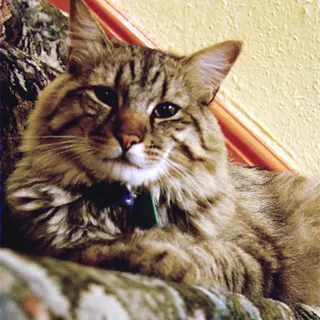
The American Curl is a medium-sized cat with a semi-foreign format, endowed with an elegant, rectangular body that is longer than it is tall. The male is generally larger than the female. Its musculature is toned and its bone structure fine. Its head, of medium size, forms an elongated triangle with softened contours, with a rounded muzzle and a firm chin. Its ears, rather large and furnished with hair, naturally curl backward in an arc of 90 to 180 degrees without hindering their mobility. Its eyes, large, spaced and walnut-shaped, can be of any color, bright shades being appreciated. There is a short-haired variety, silky and lying flat, almost devoid of undercoat, and a semi-long-haired variety, also silky and lying flat, whose tail is well furnished. All coat colors are accepted.
Temperament
Temperament and personality
The American Curl has a balanced, gentle and affectionate temperament. Very attached to its family, it enjoys cuddles and seeks regular attention. It does not tolerate prolonged solitude well. Curious, discreet and almost silent, it also knows how to be playful, especially with children. It generally tolerates its fellow cats and other animals well when they are introduced under good conditions.
Living together
Living with children and animals
Primarily suited to indoor living, the American Curl can enjoy a secured balcony or controlled access to an outdoor area. Without being a great athlete, it must be able to exercise every day and maintain good physical condition. A cat tree, a scratching post, hiding places and several toys contribute to its balance. Its gentleness, its low level of vocalization and its sociable temperament make it a pleasant companion for a family with or without children, as well as for elderly people or those with a calm lifestyle, provided that it benefits from presence and interactions.
Training
Training and socialization
The American Curl easily learns the household habits thanks to its curiosity, its intelligence and its attachment to humans. A gentle, consistent education based on reward suits its sensitivity. It is useful to get it used from a young age to brushing, to handling the paws and especially to the delicate inspection of the ears. Interactive play sessions also help to channel its energy without constraint.
Budget
American Curl price & budget
The price of an American Curl varies depending on the lineage, compliance with the standard, the reputation of the cattery, coat length, the cat’s intended purpose, and the health guarantees provided. The acquisition budget must be supplemented by regular expenses for food, preventive care, litter, and equipment.
View cost breakdownHealth
Health at a glance
The American Curl is considered a cat of solid constitution and no hereditary disease specific to the breed is highlighted by the reference sheet. Its main point of vigilance concerns its curled ears, which must be inspected and cleaned gently in order to limit irritations and infections. Like any cat, it must benefit from regular veterinary follow-up and appropriate vaccinations against typhus, coryza and leukaemia depending on its lifestyle, as well as against rabies when regulations or travel require it.
Prevention & watch pointsDiet
Feed it well
The American Curl needs a complete, high-quality diet, adapted to its age, its body condition, its activity level and any possible sterilization. The daily ration must be controlled to avoid weight gain.
Our feeding adviceDid you know?
Anecdotes and popularity
The breed descends from Shulamith, a black female cat discovered in California in 1981. Kittens are born with straight ears, then the characteristic curl gradually develops over the first weeks. This particular shape must never hinder the natural movements of the ear and requires delicate handling.