A menu for every age
Their needs change as they grow
Kitten: A complete and highly digestible growth diet is recommended to support development, with several small meals per day.
Adult: The ration must cover maintenance needs while preserving muscle mass and avoiding overweight.
Senior: With age, the diet must be adapted to activity, digestion, and kidney monitoring according to the veterinarian's advice.
Which food?
Kibble, wet food, or homemade meals?
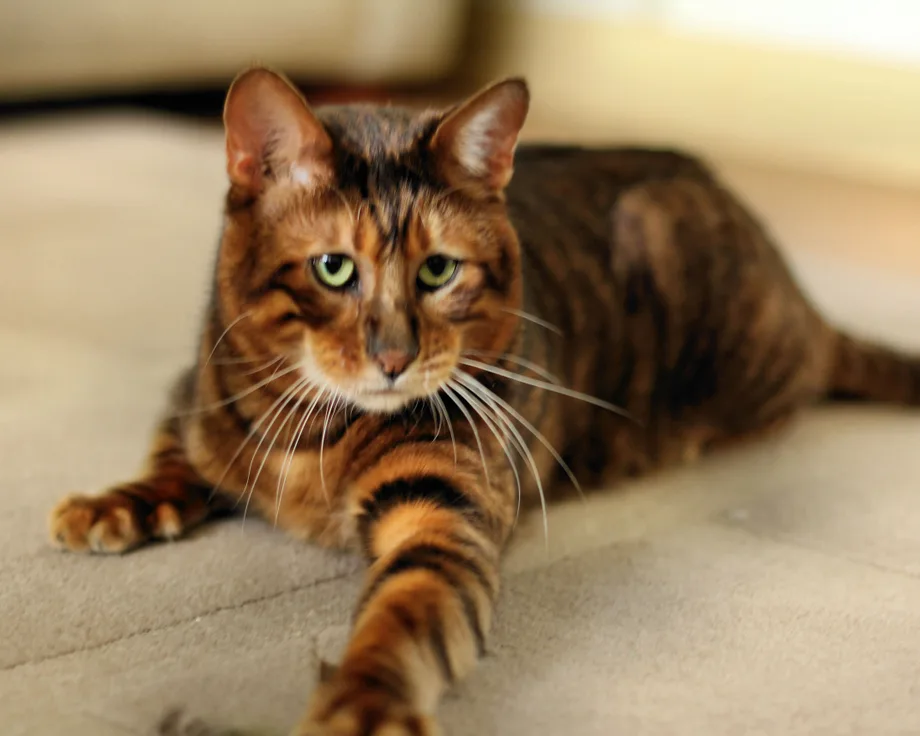
Premium kibble or a complete good-quality wet diet suit the Toyger well, provided that recipes rich in animal proteins are favored and formulas that are too loaded with filler ingredients are limited. The final choice must always take into account its age, its activity level and any possible digestive sensitivity.
Portion sizes
How much should you feed?
The daily amount varies according to weight, age, lifestyle and the energy density of the chosen food. It is preferable to think in terms of a weighed ration adjusted over time rather than free-feeding, in order to maintain good body condition.
| Weight | Daily amount | Meals per day |
|---|---|---|
| 3 - 4 kg | 54 - 78 g | 2 |
| 4 - 6 kg | 70 - 100 g | 2 |
| 6 - 7 kg | 86 - 121 g | 2 |
Changing food
How to switch foods successfully
Any dietary transition must be gradual over several days in order to avoid digestive upsets. Mixing the old and the new food in stages allows the Toyger to adapt more comfortably.
Hydration
Don't overlook water
Clean, fresh water must remain available at all times. Like many cats, the Toyger may drink in varying amounts depending on its diet, hence the benefit of encouraging hydration with several water points and, if needed, a portion of wet food.
A little extra
Treats in moderation
Treats should remain occasional and represent a small part of the daily energy intake. They can be useful for training or play, but an excess promotes weight gain.
Good habits
Make mealtimes count
- Weigh the daily ration rather than feeding by eye.
- Split meals if the cat tends to throw itself on the food.
- Introduce any new food gradually over several days.
Never feed these foods
In particular, you should avoid chocolate, onion, garlic, grapes, alcohol, coffee, cooked bones and very salty or very fatty foods, as they can cause digestive or neurological disorders, or sometimes serious poisoning in the cat.