Origins
Where does it come from?
The Savannah is a recent breed born in the United States from the cross between the Serval, a wild feline of the African savannas, and various domestic cats with spotted coats. The story begins in 1986 with a female cat born to a Siamese mother raised by Judee Frank and a Serval father. First called Miracle then Savannah, she gives birth three years later to a litter with a Turkish Angora male. Patrick Kelly then continues the development of the breed, to which Joyce Sroufe contributes notably by co-writing its first standard. The TICA accepts this standard in the early 2000s after the work of several enthusiasts and a group of 18 founding breeders. In France, the breed remains rare and the LOOF authorizes in shows only cats from the F5 generation onward.
Appearance
What does it look like?
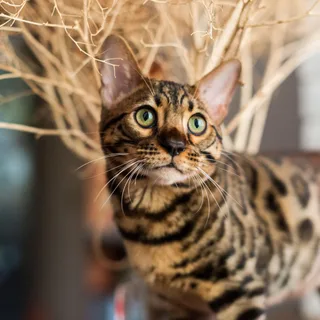
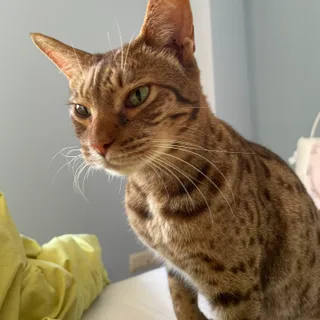
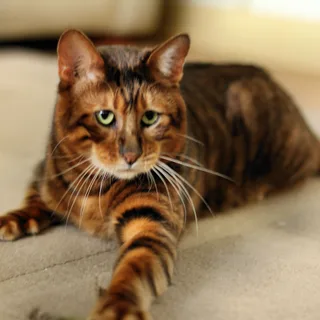
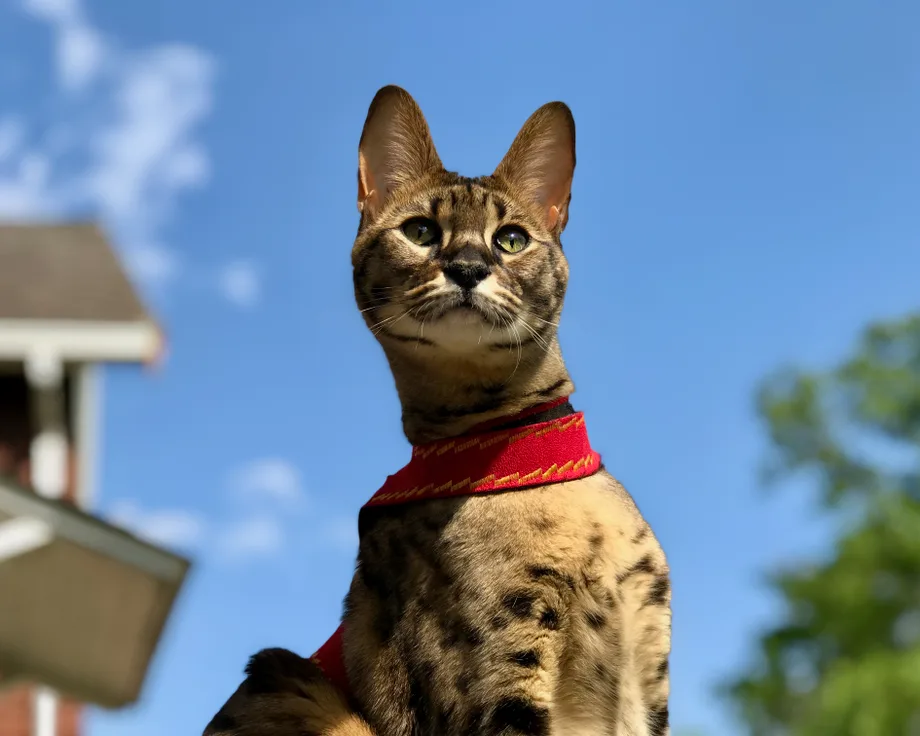
The Savannah has a body among the most imposing in cats, supported by powerful musculature. Its triangular head, longer than wide, appears rather short in relation to the body. Its large ears are set high, wide at the base and rounded at the top. Its almond-shaped eyes are green or golden. Its short coat has a color ranging from fawn to orange, covered with black spots that recall the cheetah. Its thick tail, relatively short, ends with a black tip and does not touch the ground when the cat is standing.
Temperament
Temperament and personality
Despite its partly wild ancestry, the Savannah is gentle, demonstrative and very affectionate. Intelligent, curious and athletic, it likes to play, jump and go into the water. Its temperament, however, depends greatly on the quality of its socialization and its generation. F1 and F2, closer to the Serval, generally become attached to one or two people and remain more reserved with children and strangers. More distant generations more readily give their trust and willingly enjoy games with younger ones.
Living together
Living with children and other pets
The Savannah needs sustained daily activity and a very stimulating environment. It can live in the city as well as in the countryside, provided it has enough space, a large cat tree, scratching posts, toys, platforms, tunnels and hiding places. It also enjoys walks on a leash. Careful securing of the living area is essential due to its risk of running away. If it gets bored, it can become destructive and attack clothes, shoes or furniture.
Training
Training and socialization
Early socialization plays an essential role, particularly in the generations closest to the Serval. It is advisable to gradually get it used to people, children, other animals and handling, while respecting its temperament. Its intelligence, curiosity and love of play make it possible to offer it stimulating learning experiences and to accustom it to walking on a leash.
Budget
Price and budget for the Savannah
The purchase price varies greatly depending on the generation, the breeding and the cat's characteristics. You should also plan for an annual maintenance budget estimated by the source between 300 and 600 euros.
See cost breakdownHealth
Health at a glance
The Savannah is described as a solid and robust cat, with no known genetic disease. As with other cats, vaccination is recommended in order to protect it in particular against rabies, typhus, leukemia and coryza.
Prevention and things to watch forNutrition
Feeding your pet well
Very active and strongly muscled, the Savannah needs a diet sufficiently rich in proteins and fats, adapted to its morphology and its physical expenditure.
Our feeding adviceDid you know?
Fun facts and popularity
The letter F followed by a number indicates the genealogical distance from the Serval: an F1 has a Serval father and a domestic mother, an F2 has a Serval grandfather and an F3 a Serval great-grandparent. The higher the number, the further the cat is from the Serval. In France, only Savannahs of generation F5 or later are authorized in shows by the LOOF.