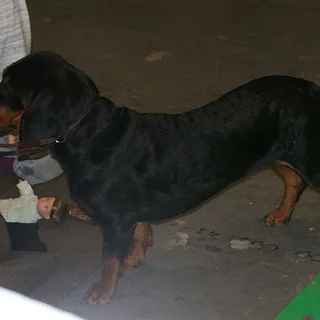
A menu for every age
Needs change over time
Puppy : Growth food for small dogs, in three meals, without forcing weight gain that overloads the back.
Adult : Weighed ration in two meals, adjusted to stay lean and muscular.
Senior : Digestible food, possibly with joint support, while monitoring mobility and teeth.
Which food?
Kibble, wet food, or home-cooked diet?
High-quality complete kibble, formulated for small dogs or for Teckels depending on the available ranges, generally works well. The ration must be balanced and not too rich in fats.
Amounts
How much should you give?
An adult Dachshund of 4 to 9 kg often receives 70 to 160 g of kibble per day depending on whether it is a kaninchen, a miniature or a standard, its activity and the density of the food. Weigh the ration and adjust according to body condition, because excess weight overloads the back.
| Weight | Daily amount | Meals/day |
|---|---|---|
| 3 - 5 kg | 60 - 95 g | 2 |
| 5 - 7 kg | 85 - 130 g | 2 |
| 7 - 9 kg | 110 - 160 g | 2 |
Change
Managing the food transition
Any dietary change must be gradual over several days in order to avoid digestive disorders and to check good tolerance of the new ration.
Hydration
Water: do not overlook it
Clean, fresh water must remain available at all times. Good hydration is particularly important during hot periods and for active dogs.
Little extras
Treats, in moderation
Treats should remain occasional and be included in the daily ration. In this greedy breed, extras that are too frequent quickly promote weight gain.
Good habits
For a top-notch bowl
- Keeping the Dachshund slim is the first preventive measure for its back.
- Avoid repeated jumps from the sofa and stairs that are too frequent, especially in the puppy.
- Splitting meals limits digestive issues in this small size.
Never give
As with other dogs, chocolate, grapes, onion, garlic, xylitol, alcohol, cooked bones and very fatty foods should be avoided, as they can cause serious digestive, neurological or metabolic disorders.