Origins
Where does it come from?
The Westphalian Basset originates from the historic German region of Westphalia, between the Weser and the Rhine. It is said to have been obtained by crossing the German Brachet with different types of bassets in order to create a scenthound lower on its legs, capable of following game over varied terrain. The German Kennel Club recognized the breed in 1935. The Swedish Basset, or Drever, was then developed from this stock. The Fédération Cynologique Internationale definitively recognized the Westphalian Basset on 29 November 1954, under standard number 100. The breed remains today quite rare outside Germany.
Appearance
What does it look like?
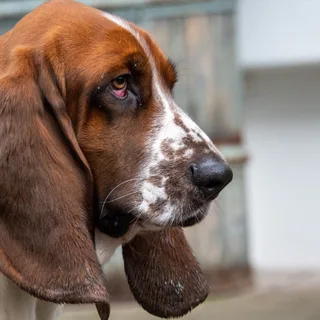
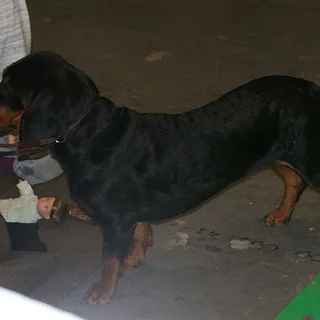
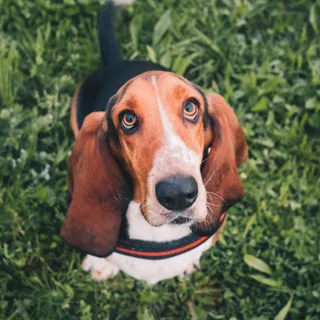
The Basset de Westphalie is a hunting dog of moderate length, with a strong, robust and compact build. Its narrow, elongated head has a noble appearance, with a skull slightly wider than the cheeks, dark eyes with a gentle but serious expression and large drooping ears with rounded tips. Its neck is strong, its loin broad, its chest relatively narrow and its belly tucked up. The tail, set on high, is strong at the base and furnished with brush-like hair underneath. Its harsh, dense coat is short on the head, ears and lower parts of the limbs, but longer on the back, neck and under the tail. The coat ranges from red to yellow with a black saddle or mantle and white markings.
Temperament
Temperament and personality
Energetic, hardy and loyal, the Westphalian Basset has a very pronounced hunting instinct. He is cheerful and affectionate with his owner, while retaining a certain independence and a relative docility. At home, he can become a pleasant family companion when his needs for activity, scent work and presence are respected. His sociability with children, strangers and other animals is generally good, but early socialization remains important.
Living together
Living with children and animals
This active dog needs long daily walks and regular activities that engage both its body and its sense of smell. It enjoys trails, searches and outings in natural environments. Its strong chasing instinct requires particular vigilance during unsecured walks. It can adapt to several lifestyles, including living in accommodation without a large garden, provided it benefits from sufficient availability, exercise and mental stimulation.
Training
Training and socialization
Training must start early and combine firmness, gentleness and consistency. Intelligent but not always very obedient, the Basset de Westphalie responds better to short, motivating and rewarded sessions than to power struggles. Recall, leash walking and giving up a trail are priority learnings due to its hunting instinct. Gradual socialization with people, dogs and other animals promotes its balance.
Budget
Westphalian Dachsbracke price & budget
The purchase price varies depending on the lineage, the reputation of the breeding kennel, compliance with the standard, health guarantees and the dog's intended purpose. The rarity of the breed outside Germany can also increase search and travel costs.
View cost breakdownHealth
Health at a glance
With a robust constitution, the Basset de Westphalie rarely falls ill and generally enjoys satisfactory health. However, its large drooping ears limit the ventilation of the ear canal and require regular monitoring, especially after walks in vegetation or in damp weather.
Prevention & watch pointsDiet
Feed it well
Its diet must cover the needs of an average, active and hardy dog without promoting weight gain. The ration depends on age, activity level, physiological state and the energy density of the food.
Our feeding adviceDid you know?
Anecdotes and popularity
The Basset de Westphalie is sometimes described as a reduced version of the German Brachet, which it strongly resembles. Its endurance and its ability to work on different terrains allow it to hunt in particular the hare, the fox and even the wild boar. It has also played a decisive role in the creation of the Swedish Drever.