Origins
Where does it come from?
Originally from Tibet, the Lhassa Apso was traditionally bred in Buddhist monasteries and in the villages around Lhassa, from which it takes its name. Very ancient, the breed did not arrive in Europe until the beginning of the 20th century, notably in Great Britain in the 1920s. The Lhassa Apso was long appreciated as an alarm and companion dog for its vigilance, its hardiness and its strong attachment to its home.
Appearance
What does it look like?
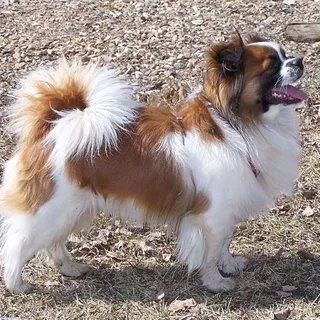
The Lhassa Apso is a small compact dog, well proportioned, with a straight topline, a strong loin and a solid silhouette for its size. Its coat is long, abundant, straight and harsh, with a medium undercoat. It has pendant ears furnished with fringes, dark oval eyes and a high-set tail, carried over the back and well furnished with hair.
Temperament
Temperament and personality
Lively, playful and attached to his family, the Lhassa Apso also shows himself to be independent and wary of strangers. His alert instinct is pronounced and he does not hesitate to signal an unusual presence with barking that is surprisingly deep for his size. With his own, he can be affectionate and protective, while keeping an assertive temperament.
Living together
Living with children and animals
This small dog enjoys indoor life and adapts well to urban daily life, provided it benefits from regular walks. It knows how to alternate calm moments and play phases, which makes it a pleasant companion for settled households. Well socialized, it can live properly with other animals, but its vigilant and independent side remains pronounced.
Training
Training and socialization
His training must be firm, consistent and fair, without brutality. The Lhassa Apso responds better to encouragement and early socialization than to repeated reprimands. It is advisable to channel early his distrust of strangers and his tendency to raise the alarm, while respecting his strong-willed nature.
Budget
Lhasa Apso price & budget
The purchase price of a Lhassa Apso varies depending on origin, the quality of the breeding, the lineage and the seriousness of the initial socialization. Beyond the initial price, you must also plan for the maintenance budget, notably for grooming and routine follow-up.
View cost breakdownHealth
Health at a glance
The Lhassa Apso is a small dog that is generally hardy and resilient. Its abundant coat helps it better withstand the cold and partly protects it from the sun, but it requires real rigor in maintenance. Regular monitoring of the ears, eyes and the condition of the skin helps preserve its daily comfort.
Prevention & watch pointsDiet
Feed it well
The Lhassa Apso needs a complete and digestible diet, adapted to its small size, its age and its activity level. Good-quality kibble generally suits it very well, with quantities adjusted according to its daily energy expenditure.
Our feeding adviceDid you know?
Anecdotes and popularity
In Tibet, the Lhassa Apso was nicknamed "dog with the roar of a lion" because of its deep bark and its proud bearing. Despite its small size, it was long valued for its role as an alarm dog in monasteries. Its name refers directly to the city of Lhassa, the historical and spiritual center of Tibet.