Origins
Where does it come from?
The Pekingese is a very ancient breed originating from China. Long considered a sacred dog at the imperial court, it enjoyed an exceptional status and its ownership was closely protected. The breed spread to Europe after the looting of the Summer Palace in Beijing in 1860, when several specimens were taken to England and then offered to prominent figures, including Queen Victoria. Today, the Pekingese remains an emblematic companion dog, appreciated for its noble appearance and its assertive temperament.
Appearance
What does it look like?
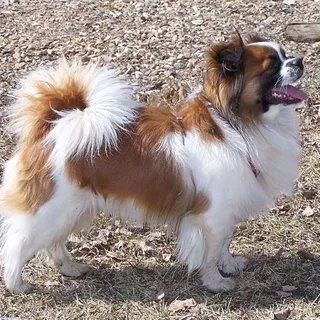
The Pekingese is a small dog with short legs, a compact body, a broad chest and a level back. Its head is broad, with round, dark eyes, heart-shaped ears richly fringed and a lively expression. Its coat is long and straight, with a pronounced mane that enhances its leonine appearance. All coat colors are permitted except liver brown and albinism.
Temperament
Temperament and personality
The Pekingese is an intelligent, loyal dog and very attached to its owner. It is calm and gentle on a daily basis with its close circle, but often remains distant, wary and more reserved towards strangers. Courageous despite its small size, it retains an assertive and independent temperament that needs to be understood and respected.
Living together
Living with children and animals
The Pekingese likes indoor life and copes well with the pace of a calm household. It does not need long outings, but appreciates short moments of walking and quiet games at home. Vigilant, it can bark quickly in case of intrusion or novelty. It is generally more at ease in a stable environment than in a very hectic family life.
Training
Training and socialization
The education of the Pekingese must be firm, consistent and always carried out without brutality. Its independence and its taste for deciding by itself make obedience less natural than in other breeds. Positive reinforcement, stable rules and the absence of laxity are essential to avoid bad habits, notably greediness and stubborn behaviors.
Budget
Pekingese price & budget
The purchase price of the Pekingese varies depending on the quality of the bloodline, the breeder’s reputation, sex and registration in the studbook. Routine upkeep remains moderate, but the budget may increase with grooming care and monitoring of the eyes or dentition.
View cost breakdownHealth
Health at a glance
The Pekingese is a small dog that is generally robust, but certain areas require regular vigilance, notably the eyes, the mouth and breathing. Its particular morphology and abundant coat require careful maintenance to preserve its comfort and limit complications.
Prevention & watch pointsDiet
Feed it well
The Pekingese’s diet must be of good quality and adapted to its small size as well as to its moderate activity level. A balanced formula helps preserve its weight, its skin, the quality of its coat and its overall comfort.
Our feeding adviceDid you know?
Anecdotes and popularity
The Pekingese has long been associated with the Chinese imperial nobility, where it was considered a sacred dog. Its small lion-like appearance is no coincidence and is part of the breed’s historical identity. After its arrival in England in the 19th century, it quickly gained popularity in European aristocratic circles.