Origins
Where does it come from?
The Basset Artésien-Normand appeared in the 1870s from the Basset de Normandie and the Basset d'Artois, two lines stemming from the first French bassets. Count Jean-Emmanuel Le Coulteux de Canteleu was looking for a utilitarian dog with straight forelegs, while Louis Lane favored the Norman type with twisted forelegs. The current name became established at the beginning of the 20th century. A first standard was established in 1898, then the breed was made official in 1924 before spreading notably in England and the United States. The Fédération Cynologique Internationale recognized it on 29 October 1963 under number 34, in group 6.
Appearance
What does it look like?
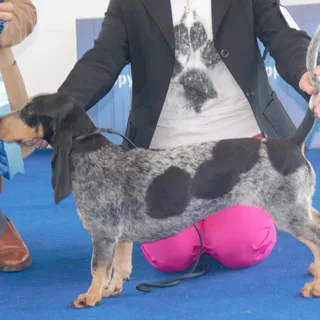
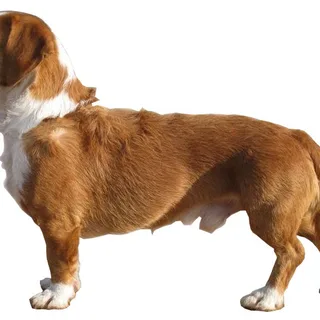
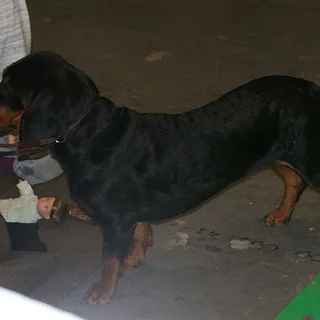
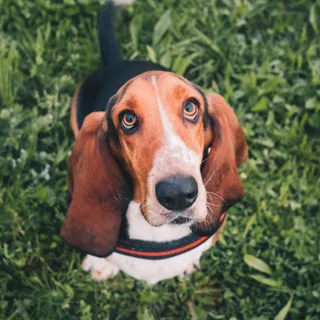
This medium-sized basset presents a long, low, compact and well-set silhouette. Its back is broad and strong, its loins slightly arched and its croup a little sloping. The long head has a skull of medium width, a pronounced stop, a large black nose and a muzzle as long as the skull. The large oval eyes are dark. Set low, the ears are fine, supple, very long and ending in a point. The close, short and dense coat can be tricolour, with a fawn dominance and a black and white mantle, or fawn and white bicolour. The tail, long, is carried sabre-like.
Temperament
Temperament and personality
Gentle, affectionate and cheerful, the Basset Artésien-Normand is a lovable dog that seeks the company of its loved ones. Lively, playful and courageous, it generally appreciates children. Its intelligence and its scent hound temperament make it an excellent assistant for hunting rabbit, hare and roe deer. Docile and obedient when it is well guided, it nevertheless retains a certain stubbornness and a pronounced hunting instinct. It is not naturally aggressive nor particularly protective.
Living together
Living with children and animals
On a daily basis, this pack dog does not tolerate solitude well and thrives in contact with its family or with properly introduced fellow dogs. It likes to sniff, explore, run and take part in its owners' activities. Life in an apartment remains possible if long outings are offered to it every day, but housing with a secure outdoor space suits it better. Its scenthound voice can be heard, especially when it is following a trail or lacks stimulation.
Training
Training and socialization
Training must start early and combine firmness, gentleness and consistency. Its intelligence makes learning easier, but its charming and stubborn side requires stable rules as well as short and motivating sessions. Recall deserves careful work because of its chasing instinct. Early socialization with people, dogs and other animals promotes its balance. Coercive methods should be avoided in favor of positive reinforcement.
Budget
Basset Artésien Normand price & budget
The purchase price varies depending on the reputation of the breeding kennel, the quality of the bloodline, registration with the LOF, health guarantees and the dog's intended purpose. The relative rarity of the breed can also influence the availability of litters.
View cost breakdownHealth
Health at a glance
The Basset Artésien-Normand is generally robust and the reference source does not report any systematic hereditary disease. Its low and elongated morphology nevertheless requires particular attention to the spine, joints and limbs. Its long drooping ears must also be checked regularly in order to limit ear infections.
Prevention & watch pointsDiet
Feed it well
A complete, balanced and good-quality diet helps support its activity while limiting the risk of becoming overweight. Intake must be adapted to the life stage, exercise level and body condition, with regular weight monitoring.
Our feeding adviceDid you know?
Anecdotes and popularity
An excellent pack dog originally, the Basset Artésien-Normand is today also appreciated as a family companion. The breed remains small in number, with around 200 births registered with the LOF per year according to the testimony of a breeder cited by Woopets. Its FCI standard bears number 34 and its definitive recognition dates from 29 October 1963.