Origins
Where does it come from?
The Chien d'Artois is an ancient French breed of scenthound, recognized for centuries for its hunting qualities. Highly appreciated in the time of Henri IV and Louis XIII, it was then often called Chien Picard. After a long decline, then a critical period after the Second World War, several enthusiasts worked for its preservation and the reconstitution of its old type, allowing the breed to be preserved.
Appearance
What does it look like?
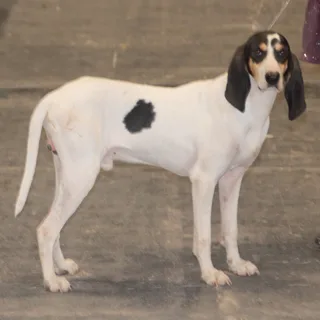
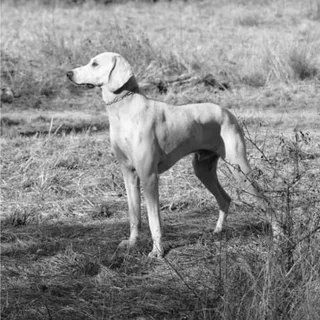
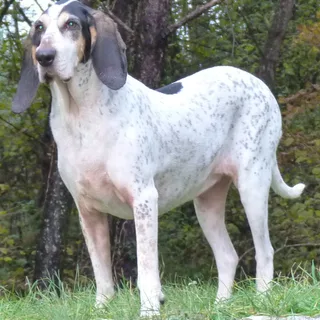
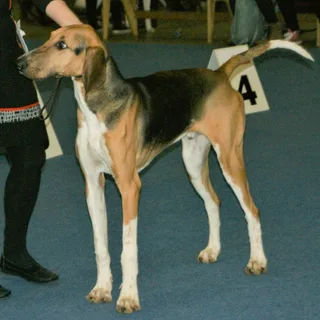
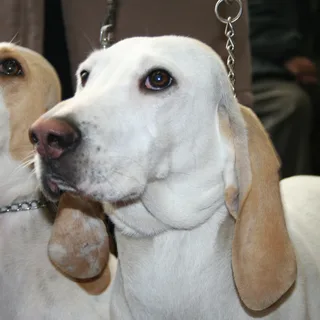
The Chien d'Artois is a solidly built dog, of moderate size, with a robust bone structure and well-developed musculature. Its body is not too long, its back is broad, its chest deep and well let down, and its overall appearance gives an impression of strength, energy and vigor. Its coat is short, flat and of fairly good thickness, most often dark fawn tricolor with a saddle or large markings.
Temperament
Temperament and personality
The Chien d'Artois has a balanced temperament, affectionate with those close to him and diligent in his work. It is a passionate hunting dog, endowed with a very keen sense of smell, which likes to work in a pack and shows itself willing in the field. It knows how to show its attachment, while keeping a true autonomy as a scenthound.
Living together
Living with children and animals
Active by nature, the Chien d'Artois needs long daily outings and an environment that allows it to expend energy. It is quite vocal, likes to follow a trail and does not tolerate a life that is too confined. In a family, it can be pleasant and stable if its physical and mental needs are properly met.
Training
Training and socialization
His training must begin early, particularly on recall and the management of his chasing instinct. The Chien d'Artois is not the most obedient of dogs, but he learns willingly with a consistent method, firm and gentle at the same time. Short, regular and motivating sessions give better results than an approach that is too harsh.
Budget
Artois Hound price & budget
The Chien d'Artois is a relatively rare breed, which can influence its availability among specialized breeders. The price mainly depends on the lineage, the seriousness of the breeding, compliance with the standard, and the rarity of the available litters.
View cost breakdownHealth
Health at a glance
The Chien d'Artois is a hardy dog and generally robust when it benefits from a suitable lifestyle, regular veterinary follow-up and a diet consistent with its activity. Like many active scent hounds, it maintains good physical condition when it goes out often and keeps a stable weight.
Prevention & watch pointsDiet
Feed it well
The Chien d'Artois needs a balanced, digestible and good-quality diet, adapted to its age, its size and above all to its level of activity. During hunting periods or sustained exercise, its energy needs increase and the ration must be adjusted accordingly.
Our feeding adviceDid you know?
Anecdotes and popularity
The Chien d'Artois has borne several names throughout its history, including Grand Chien d'Artois, Picard and Briquet d'Artois. Its reputation as a hunter appears in French hunting literature, and its modern survival owes much to the efforts of breeders and enthusiasts who revived the breed in the 20th century.