Origins
Where does it come from?
The Billy descends from the old "white dogs of the King", French lines that made up the royal packs for more than two centuries. In the 19th century, Gaston Hublot de Rivault developed the breed in Poitou from dogs such as the Montembeuf and the Céris, then gave it the name of his Billy estate, located near Poitiers. The Fédération Cynologique Internationale has recognized the breed since 1963 and the official standard currently in force was published on 28 December 1973. The Billy remains a rare scenthound, mainly selected for mounted hunting and pack work.
Appearance
What does it look like?
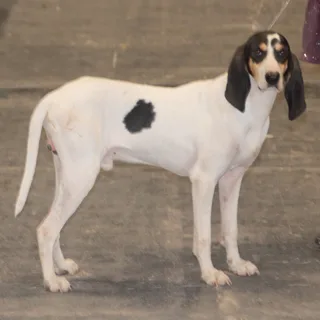
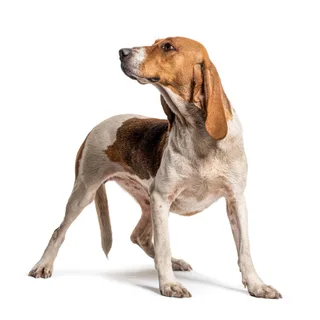
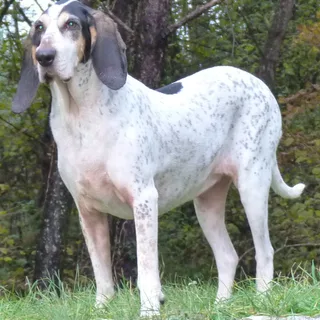
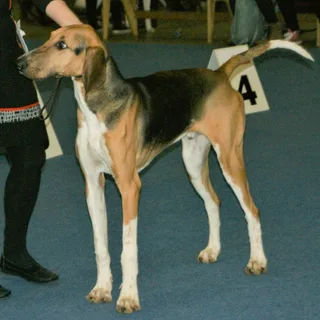
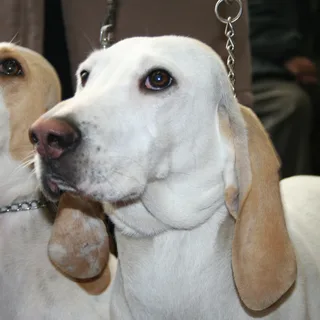
The Billy is a large, harmonious scenthound that combines power, elegance and lightness. Its medium-length body has a strong back, a well let-down chest, rather flat ribs and a sloping croup. Its fine, lean head, with a slightly domed forehead, has dark, lively eyes as well as flat ears, of medium size and set high. Its very short coat, sometimes close-cropped, is harsh and thick. The coat can be entirely white, café au lait, or white with light orange or lemon markings. Its long tail is strong and can be quite well furnished.
Temperament
Temperament and personality
Active, intelligent and very hardy, the Billy is deeply attached to its owner and pleasant with its family. It particularly appreciates children when they respect its needs and its space. Its hunting instinct, its scenting ability and its tenacity are very pronounced. Generally not very prone to biting and moderately protective, it is not intended for guarding. Early socialization is important, as its relationships with other dogs can be delicate and its chasing instinct requires caution with small animals.
Living together
Living with children and animals
The Billy needs to run, to scent and to cover long distances every day. Simple hygienic walks are not enough for his balance. He thrives in the countryside, with an available owner who offers him long outings, tracking activities and a secure environment. At home, he can be calm after sufficient exercise, but boredom and inactivity encourage vocalizations, frustration and escape attempts. Apartment living and long repeated absences suit him poorly.
Training
Training and socialization
Billy’s training must start early and be based on consistency, calm firmness and motivating rewards. His intelligence makes learning easier, but his independence as a scenthound and the strength of his hunting instinct can make recall more difficult. This must be worked on gradually in enclosed places before any freedom in open spaces. Quality socialization with well-balanced dogs helps to limit tensions between dogs. Brutal methods must be avoided, as they harm trust without improving cooperation.
Budget
Billy price & budget
The Billy is a rare French breed whose price depends mainly on the quality of the breeding, the pedigree, health selection and the abilities of the ancestors. The acquisition cost represents only part of the budget, because this large active dog requires quality food, travel, sturdy equipment and regular veterinary follow-up.
View cost breakdownHealth
Health at a glance
The Billy is a hardy dog and generally robust. Its health depends above all on well-prepared activity, a diet suited to its energy expenditure and attentive monitoring after outings on rough terrain. As with any large sporting dog, the joints, paw pads, ears and digestion deserve regular vigilance.
Prevention & watch pointsDiet
Feed it well
This large scenthound needs a complete, digestible diet adjusted to its actual level of activity. The energy expenditure of a Billy used for hunting can be much higher than that of a dog at rest. The intake must therefore evolve gradually according to the season, without a permanent excess of fats or proteins.
Our feeding adviceDid you know?
Anecdotes and popularity
The name of the breed does not come from an English first name, but from the Billy estate, near Poitiers, where Gaston Hublot de Rivault established the breed in the 19th century. Heir to the old white dogs of the royal packs, the Billy can cover several tens of kilometers during a day of hunting. Its light coat and slender appearance recall this old French selection for work in open terrain.