Origins
Where does it come from?
The distant ancestors of the Italian Scenthound are believed to be the scenthounds of ancient Egypt, probably brought to the Italian peninsula by Phoenician merchants. Dogs showing similar physical characteristics appear in several works of art, notably the statues of Diana the Huntress kept at the Naples Museum and of Diana drawing a bow at the Vatican Museum.
Appearance
What does it look like?
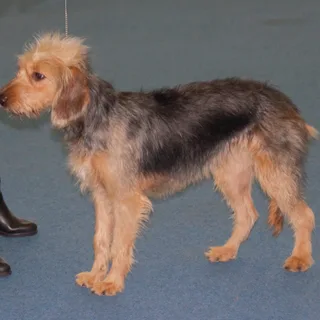
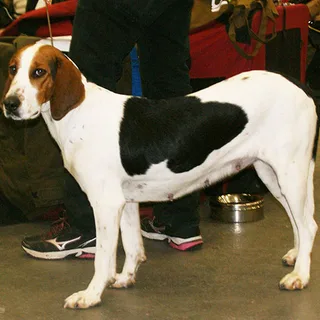
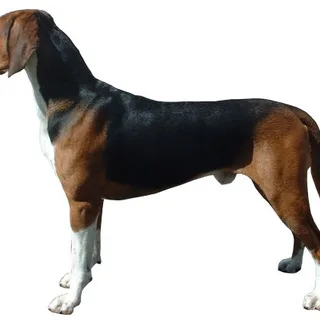
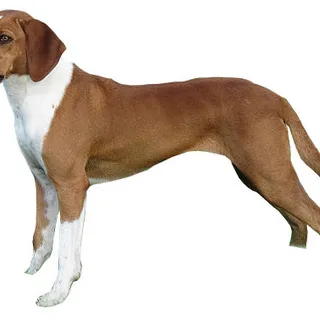
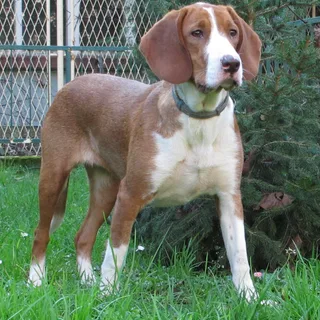
The Italian Scenthound is a medium-sized hunting dog, robust, harmonious and lean, endowed with clear musculature, without fat, and with a well-developed bone structure. Its body is almost inscribable in a square, with a straight back, a slightly convex and muscular croup, a well-rounded chest without being barrel-shaped and a straight underline. Its oblong head has an almost oval skull, a little marked stop, a large black nose, a muzzle representing about half the length of the head and jaws articulated in scissors, the pincer bite also being accepted. Its large almond-shaped eyes, dark ochre, express gentleness. Its rectangular ears, wide, flat, drooping and twisted are projected forward. The tail, set on high, remains fine up to its tip. Two varieties exist: the short-haired one, with a very short, dense, close-lying and smooth coat, and the wire-haired one, with rough hair of about 5 cm, softer on certain regions. The coat can be solid fawn in all its shades or black and tan.
Temperament
Temperament and personality
The Italian Scenthound combines the qualities of a dog specialized in pursuing game, with a preference for hare and wild boar. Fast and robust, it can work alone or in a pack on varied terrain and readily gives voice. Within its family, it is very attached to its owner and gets along rather well with children. Its temperament is balanced, moderately independent and sensitive.
Living together
Living with children and animals
Active and athletic, the Italian Hound needs space, freedom and long daily walks. A house with a large, well-fenced garden meets its needs better than an apartment. Its very strong hunting instinct requires particular vigilance during outings and learning a reliable recall.
Training
Training and socialization
Learning recall is essential in the Italian Scenthound, as in most hunting dogs. Its training must combine firmness and gentleness in order to obtain balanced behavior without hurting its sensitivity. Its cooperation requires consistency and a coherent method.
Budget
Italian Hound price & budget
The estimated annual maintenance budget covers the routine expenses related to the feeding, care and upkeep of the Italian Hound, excluding the purchase price.
View cost breakdownHealth
Health at a glance
The Italian Hound enjoys overall robust health. No particular predisposition to a disease is reported for this breed. A litter generally includes 4 to 6 puppies.
Prevention & watch pointsDiet
Feed it well
The Italian Hound needs a balanced, rich and high-quality diet, adapted to its age, its size and its level of physical activity.
Our feeding adviceDid you know?
Anecdotes and popularity
The breed includes two varieties, the Italian Short-haired Hound and the Italian Rough-haired Hound. It is also known under the names Italian Cour Hound, Segugio Italiano a pelo raso and Segugio Italiano a pelo forte. It belongs to FCI group 6, bears standard number 337 and has been recognized by the FCI since 1956 as well as by the AKC.