Origins
Where does it come from?
The development of the Hygen Hound begins towards the end of the 19th century. The paternity of the breed is attributed to H. F. Hygen, a Norwegian breeder who gave it his name. By crossing different varieties of Swiss, German and Scandinavian scenthounds, he obtains a hardy and enduring hunting dog. The FCI has recognized the breed since 1965 under number 266. It remains very little known outside Norway.
Appearance
What does it look like?
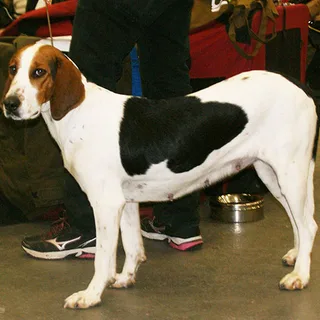
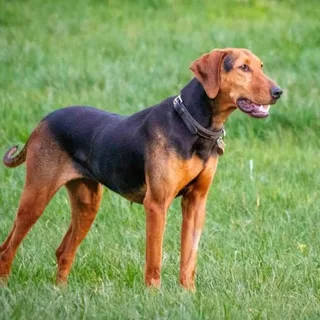
The Hygen Hound is a medium-sized hunting dog, robust and compact, whose body is longer than it is tall. Its head of medium dimensions is slightly wedge-shaped, with a somewhat domed skull, a well-marked stop, a black nose and scissor-articulated jaws. Its dark brown eyes express seriousness and calm. Its ears, set at medium height, are rounded, supple and not very thick. The neck is strong, the back short and powerful, the loin broad and muscular, the chest well let down and the belly moderately tucked up. The tail, thick at the base, extends the topline and is carried straight or slightly curved. The coat is straight, dense, glossy, ideally harsh and slightly more abundant behind the thighs and on the tail. The coat colour may be red-brown or charcoal yellow-red with or without white, black and tan with white, or white ticked with brown, yellow-red or black and tan. Its movement is free and its strides are long.
Temperament
Temperament and personality
Full of energy, hardy and tenacious, the Hygen Hound fully expresses its qualities when hunting. Versatile, it also has real aptitudes for guarding. In the family, it is appreciated for its gentleness, its calm and its attachment to its owner. Sensitive, it responds better to a balanced relationship than to a show of force.
Living together
Living with children and animals
The Hygen Hound is better suited to a life close to nature than to an urban environment. It needs a large, well-fenced garden and long daily walks, ideally in wooded or rural areas. Its hunting instinct is very pronounced, its protective temperament is strong, and it can be very vocal. Its sociability with children and other animals is average, while it remains rather reserved towards strangers.
Training
Training and socialization
His training must begin early and combine firmness, consistency and gentleness. Brutality and power struggles must be avoided, because this dog is sensitive. His attachment to his owner and his predispositions for work make learning easier when the methods are respectful and regular.
Budget
Hygen Hound price & budget
The acquisition cost varies notably depending on the breeder, the lineage and the guarantees provided regarding the origin and health of the puppy.
View cost breakdownHealth
Health at a glance
The Hygen Hound enjoys fairly robust health. Its sturdiness and endurance allow it to face difficult hunting terrain and the harsh climatic conditions of its region of origin.
Prevention & watch pointsDiet
Feed it well
The Hygen Hound needs a balanced, high-quality diet, adapted to its level of physical activity, its size and its age.
Our feeding adviceDid you know?
Anecdotes and popularity
The Chien courant de Hygen is also called Hygenhund. Its name pays tribute to the Norwegian breeder H. F. Hygen. The breed is recognized by the FCI and the UKC, but remains very rare outside Norway. A litter generally has 3 to 6 puppies.