Origins
Where does it come from?
Of Swedish origin, the Hamilton Hound is said to have been obtained from crosses between various varieties of European scenthounds, coming mainly from Germany, Switzerland and Great Britain. The first known representatives were presented at a dog show in Sweden in 1886: Pang and Stella, a couple belonging to Count Adolf Patrick Hamilton. The breed was developed from these two dogs and took the name Hamilton Hound in 1921. It bears the number 132 of the FCI, which has recognized it since 1955 within group 6.
Appearance
What does it look like?
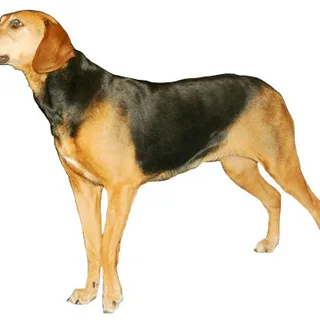
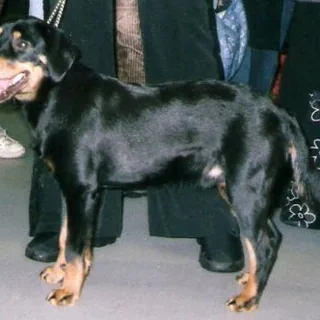
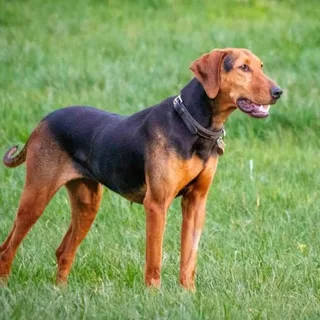
Medium-sized hunting dog, strong and vigorous without heaviness, it has a harmonious body longer than it is tall. Its neck is long and powerful, its withers well defined, its back straight and strong, its loin muscular and slightly arched, its croup long, broad and somewhat sloping, and its chest well let down. Its rather long head has a slightly domed skull, a well-defined stop, a black nose, an almost rectangular muzzle and scissor jaws. The dark brown eyes express calm. The ears, set rather high, are soft and lie close to the cheeks. The tail, thick at the base then tapering, is carried straight or slightly sabre-like. The coat is short, harsh and close-lying, smoother on the head, ears and the front of the limbs. The coat colour is tricolour: black on the top of the neck, the sides of the body and the top of the tail, tan from gold to reddish brown on the head, ears and limbs, with a blaze and white markings on the muzzle, neck, forechest, tip of the tail and the lower parts of the limbs.
Temperament
Temperament and personality
Friendly and even-tempered, the Hamilton Hound is affectionate and very attached to its owner. Its guarding instinct remains moderate, while its hunting qualities are very pronounced: it is determined, hardy, endowed with a fine nose and capable of giving voice. It generally prefers to hunt alone with its handler rather than in a pack, notably hare and fox. It can be independent and its relationship with children, strangers and other animals is generally average, which makes early socialization useful.
Living together
Living with children and animals
Active and playful, this dog does not tolerate long inactivity well. It needs to walk, run and explore every day, with long walks and outings allowing it to satisfy its sense of smell safely. It is clearly more comfortable in the countryside than in the city. An urban life remains possible with a large, well-fenced garden and frequent walks, but an apartment suits it poorly.
Training
Training and socialization
His training requires consistency, a certain firmness and a lot of gentleness, because this sensitive dog cannot tolerate brutality. His independence and hunting instinct can complicate learning. Recall must be worked on very early and maintained regularly, with positive methods, clear boundaries and progressive socialization.
Budget
Hamiltonstövare price & budget
The purchase price depends in particular on the breeder, the pedigree, compliance with the standard and the dog's intended use. The observed annual maintenance budget is generally between 450 and 650 euros, excluding exceptional veterinary expenses.
View cost breakdownHealth
Health at a glance
The Hamilton Hound is generally robust when it receives regular and appropriate care. It is not hypoallergenic. A litter generally has 4 to 8 puppies. Particular vigilance concerns the joints, the risk of gastric torsion, epilepsy and occasional ear infections.
Prevention & watch pointsDiet
Feed it well
The Hamilton Hound needs a quality diet, adapted to its age, its size, its body condition and its level of physical activity. Needs may increase during hunting periods or sustained training.
Our feeding adviceDid you know?
Anecdotes and popularity
The Hamilton Hound is also called the Swedish Hound and Hamiltonstövare. Its name pays tribute to Count Adolf Patrick Hamilton, owner of Pang and Stella, the couple presented in 1886 from which the breed was developed. The FCI, the AKC, the ANKC, the British Kennel Club, the UKC and the NZKC recognize the breed.