Origins
Where does it come from?
Originally from Spain, the Spanish Hound is mentioned as early as the 14th century in hunting literature. King Alfonso XI of Castile, who lived from 1311 to 1350, refers to it in his book on hunting with hounds. In the 16th century, the historian Gonzalo Argote de Molina in turn mentions it in his writings. The Fédération Cynologique Internationale has recognized the breed since 1957 under number 204, within group 6 devoted to scent hounds, tracking dogs and related breeds.
Appearance
What does it look like?
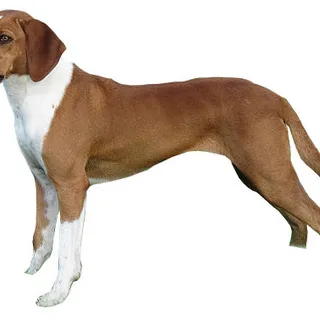
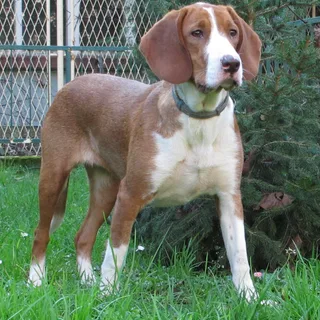
Of medium size and of longilinear build, the Spanish Hound has a body clearly longer than it is tall, a compact bone structure and solid, relatively short limbs. Its very developed chest has a girth one third greater than the height at the withers. The head, long and harmonious, carries very long pendant ears, rectangular and rounded at their tip. The hazel, almond-shaped eyes express intelligence and nobility. The coat is short, fine, dense and lying flat. The coat colour is bicolour white and orange, with well-defined irregular patches and without speckling. The tail, thick at the base and ending in a brush, is carried slightly curved at rest then sabre-like in action.
Temperament
Temperament and personality
Courageous and determined in hunting, the Spanish Hound excels in blood tracking. Specialized in small game, notably the hare, it can also work on wild boar, deer, roe deer, bear or fox. It readily gives voice to guide the hunter. In its home, it is affectionate and rather calm, while retaining a hunting dog temperament, a certain independence and a very pronounced pursuit instinct.
Living together
Living with children and animals
Its need for exercise is moderate, but it requires long walks, ideally out in nature. It prefers life in the countryside and is not naturally comfortable in an apartment. An urban life remains possible if its outings are long, regular and sufficiently stimulating. Its pronounced vocalization and its powerful hunting instinct must be taken into account on a daily basis, notably during walks and encounters with small animals.
Training
Training and socialization
Its training is fairly simple provided that consistency, measured firmness and motivation are combined. Obedience is not its strong point, but its attachment to its owner and its willingness to work make learning easier. Recall must be taught very early and maintained regularly due to its tracking instinct. Early socialization is also important to guide its relationships with children, strangers and other animals.
Budget
Spanish Hound price & budget
The price of a Spanish Hound varies depending on the lineage, the seriousness of the breeding, the screenings and the socialization. The maintenance budget (food, veterinarian, training) often exceeds the purchase price over time.
View cost breakdownHealth
Health at a glance
The Spanish Hound benefits from a robust constitution and generally sound health. No major systematic predisposition is attributed to the breed, but monitoring of the hips, eyes and ears remains recommended.
Prevention & watch pointsDiet
Feed it well
The Spanish Hound needs a balanced, high-quality diet, adapted to its age, size and level of physical activity. Expenses related to hunting must be taken into account without maintaining a high ration outside periods of exertion.
Our feeding adviceDid you know?
Anecdotes and popularity
The Spanish Hound is also known as the Sabueso Espanol. An ancient breed from the Iberian Peninsula, it appears in hunting writings dating back to the 14th century. Its international standard is registered by the FCI under number 204 and the breed has been recognized since 1957.