Origins
Where does it come from?
Breeding of the German Wirehaired Pointer began around the end of the 19th century from the Korthals Griffon and contributions from other local hunting dog breeds. It notably inherits from the Korthals Griffon its characteristic beard and eyebrows. Selection work then made it possible to obtain the current versatile dog, which quickly became popular in Germany. The Fédération Cynologique Internationale definitively recognized the breed on 26 November 1954 under number 98, in group 7 of pointing dogs.
Appearance
What does it look like?
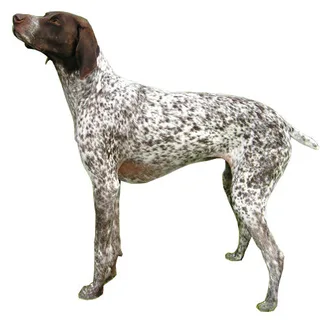
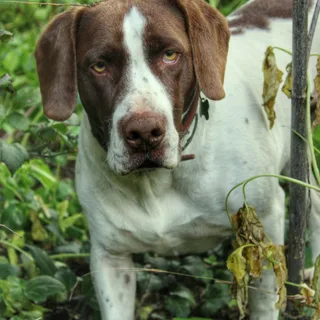
The German Wirehaired Pointer has a harmonious and well-proportioned build, a lively and alert expression as well as supple and ample gaits. Its neck of medium length is well muscled, its back is strong, its loin short and its chest broad and well let down. Its head is proportionate to the body, with a flat skull slightly rounded on the sides, pronounced brow ridges and a visible stop. Its ears are of medium size, set high and broad, and its eyes as dark as possible. Its topcoat, lying flat, dense and harsh measures 2 to 4 cm and is accompanied by a tight undercoat. The coat can be brown and white, grizzled black or light roan. The tail, of medium thickness, is carried horizontally or slightly sabre-like.
Temperament
Temperament and personality
Self-confident, steady and well-balanced, the German Wirehaired Pointer is neither fearful nor aggressive. He may be reserved with strangers. Very attached to his owner, he is a good family companion who gets along rather well with children and other animals. When hunting, he stands out for his versatility both before and after the shot, in open country, in the woods and in marshland.
Living together
Living with children and animals
This active dog needs long and frequent outings to burn off energy. It prefers to have a fenced garden, but can adapt to city life if its walks are sufficient. Its double coat, harsh and dense, offers it good protection against bad weather and cold. It has two seasonal shedding periods, in spring and in autumn.
Training
Training and socialization
Early recall training is essential in this hunting dog. Its education is not particularly complicated, but it must be rigorous, firm, gentle and patient, without brutality. Its intelligence and its desire to please its owner facilitate learning.
Budget
German Wirehaired Pointer price & budget
The purchase price varies depending on the breeder and the dog's characteristics.
View cost breakdownHealth
Health at a glance
The German Wirehaired Pointer is robust and generally enjoys solid health. Its dense double coat protects it fairly well from bad weather and cold. Vigilance remains necessary regarding its weight, hips and eyes.
Prevention & watch pointsDiet
Feed it well
The German Wirehaired Pointer is an active pointing dog that needs a complete diet, sufficiently energetic on hunting days or during long outings, and more moderate at rest. Good digestibility and weight control protect the joints.
Our feeding adviceDid you know?
Anecdotes and popularity
The breed is also known under the names German Wirehaired Pointer and Deutsch Drahthaar. Its FCI standard bears number 98 and its definitive recognition dates from 26 November 1954.