Origins
Where does it come from?
As its name indicates, the Braque d'Auvergne originates from the region of the volcanic massif of Cantal. It was in Auvergne that the breed as it is known today was developed and stabilized. Present for more than 200 years in this region, this dog comes from selections that particularly enhanced its hunting qualities. The Fédération Cynologique Internationale definitively recognized the breed on 30 June 1955, under standard number 180.
Appearance
What does it look like?
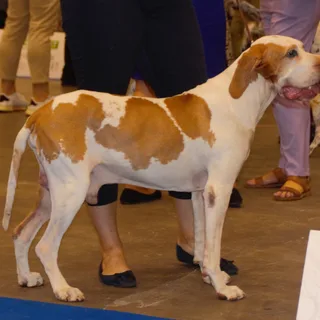
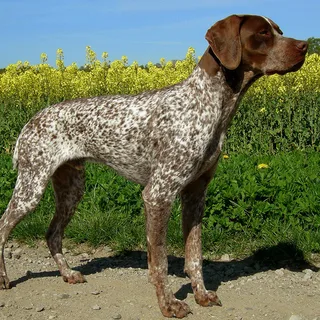
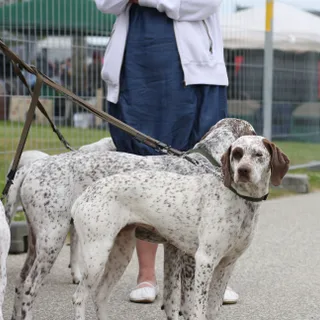
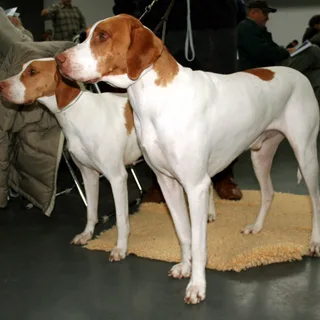
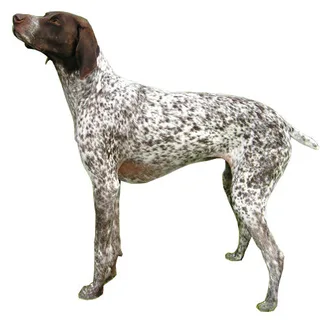
The Braque d'Auvergne has a harmonious silhouette and light gaits. Its head is long and well-proportioned, with a well-pronounced brow ridge, a moderately marked stop and large dark hazel oval eyes with an expressive look. Its supple ears, slightly silky and rounded at their tip, are set on towards the back. Its body is harmoniously built, with a rather long neck, a marked withers, a narrow back and a long, deep chest. Its tail, set on fairly high, is carried horizontally and reaches at most the point of the hock. Its coat is short and shiny, black and white speckled or roaned in colour.
Temperament
Temperament and personality
The Braque d'Auvergne stands out for its tenderness, its great attachment to its owners and to its family, as well as for its obedience. It gets along rather well with children, its fellow dogs and other animals in general. An accomplished pointing dog, it has a highly developed sense of smell and remarkable endurance that allows it to cover long distances.
Living together
Living with children and animals
Active and playful, the Braque d'Auvergne needs long, frequent walks, ideally in the forest or in the countryside, in order to preserve its physical and psychological balance. It is better suited to a house with a large fenced garden, preferably in a rural setting, but can live in the city if it benefits from sufficient daily outings.
Training
Training and socialization
As with any hunting dog, recall must be learned as early as possible. The Braque d'Auvergne is no more difficult to train than other dogs in its category. A balance between firmness and gentleness makes it a pleasant companion for life and hunting, while intelligent training develops its many natural qualities.
Budget
Braque d'Auvergne price & budget
The purchase price varies depending on the breeder and the puppy’s characteristics. The reference sheet places the Braque d'Auvergne in an affordable price range for a purebred hunting dog.
View cost breakdownHealth
Health at a glance
The Braque d'Auvergne is robust and rather resilient. Overall, it does not present any major health problems, but certain dermatological and digestive predispositions warrant appropriate monitoring.
Prevention & watch pointsDiet
Feed it well
The Braque d'Auvergne is an active pointing dog that needs a complete diet, sufficiently energy-rich on hunting days or during long outings, and more moderate at rest. Good digestibility and weight control protect the joints.
Our feeding adviceDid you know?
Anecdotes and popularity
The breed is closely linked to the Cantal massif, where it has been present for more than two centuries. It has been recognized by the FCI since 1955 and bears standard number 180. A litter generally includes 3 to 10 puppies.