Origins
Where does it come from?
The Entlebuch Cattle Dog is the smallest of the four Swiss cattle dogs. It takes its name from the Entlebuch, a valley located between the cantons of Lucerne and Bern. Described for the first time in 1889, it was long confused with the Appenzell Cattle Dog. Albert Heim presented the first specimens of the breed at the Langenthal dog show in 1913. The first standard was established in 1927, one year after the creation of the Swiss Entlebuch Cattle Dog Club. First used for driving and guarding herds, it is today appreciated as a versatile utility dog and companion dog. The FCI definitively recognized the breed on 28 July 1954.
Appearance
What does it look like?
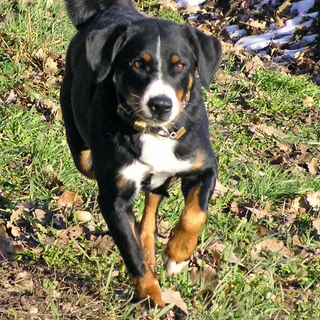
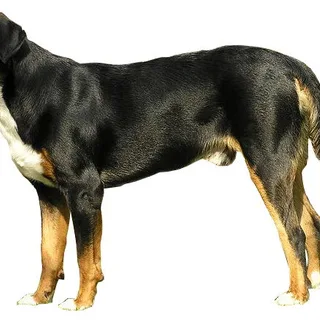
Of medium size, compact and slightly longer than tall, the Entlebuch Cattle Dog has a robust and mobile constitution. Its lean and well-proportioned head has a rather flat and broad skull, a black nose and dark brown to hazel eyes with an alert expression. Its ears, set high, rest against the cheeks when calm and are carried forward when it is attentive. Its short, harsh, close-lying and glossy coat covers a dense undercoat. Its coat is tricolour, on a black background with tan and white markings. Its back is straight and firm, its chest broad and well let down, and its tail naturally prolongs the line of the croup.
Temperament
Temperament and personality
Lively, cheerful, confident and courageous, the Entlebuch Cattle Dog is gentle, loyal and affectionate with its family. Its vigilance and reserve towards strangers make it a good guard dog. Intelligent and naturally inclined to work, it likes to learn and to please its owner. Early socialization helps to channel its wariness and its chasing instinct, while shared activities strengthen its balance.
Living together
Living with children and animals
Very energetic and playful, this working dog needs long daily walks, varied exercises and mental stimulation. A house with a well-fenced garden suits him particularly well, without replacing outings. Apartment living remains possible only with a very available and active owner. Properly exercised and gradually accustomed, he can stay alone for a few hours, but he tolerates a sedentary life poorly. His vigilant temperament can also make him very vocal.
Training
Training and socialization
His training must begin early and combine firmness, consistency and gentleness. Receptive to work and eager to cooperate, he progresses with short, regular and motivating sessions based on positive reinforcement. Recall, leash walking, calmness and control of barking must be worked on from a young age. Search games, obedience, tracking and dog sports make good use of his energy and his taste for learning.
Budget
Entlebucher Mountain Dog price & budget
The purchase price varies depending on the reputation of the breeding kennel, the quality of the health selection, the pedigree, the puppy’s intended purpose and the rarity of the breed. The budget must also include the initial expenses and the monthly costs related to food, health, insurance and equipment.
View cost breakdownHealth
Health at a glance
The Entlebuch Cattle Dog is a generally robust and resilient dog when it receives appropriate care, a balanced diet and sufficient activity. Its double coat protects it well from cold and moisture. Like any breed, it nevertheless benefits from regular veterinary follow-up and screening for hereditary conditions known in its bloodlines.
Prevention & watch pointsDiet
Feed it well
Its diet must cover the needs of a very active medium-sized dog while maintaining a lean silhouette. The ration is chosen according to age, weight, body condition, exercise level and neutering, then adjusted to the dog's actual development.
Our feeding adviceDid you know?
Anecdotes and popularity
The name Entlebuch refers to a Swiss valley located between Lucerne and Bern. The smallest representative of the Swiss mountain dogs, it shares with them the black, tan and white tricolour coat. Long confused with the Appenzell Mountain Dog, it acquired its own standard in 1927. Its qualities as a herding dog, a guard dog and a versatile dog explain its attachment to work and its great mobility.