Origins
Where does it come from?
As early as 1853, the Swiss Friedrich von Tschudi precisely described the Appenzell Cattle Dog in his work "Tierleben der Alpenwelt", devoted to life in the alpine environment. From 1895, the head forester Max Sieber undertook steps with the Swiss Cynological Society in order to preserve and promote the breed. Dogs were then presented at the Altstätten fair, then at the first international exhibition in Winterthur. The Swiss Appenzell Cattle Dog Club was founded in 1906 and Professor Albert Heim published a first valid standard in 1914. The Fédération Cynologique Internationale recognized the breed in 1954; the FCI standard currently in force was published on 25 March 2003.
Appearance
What does it look like?
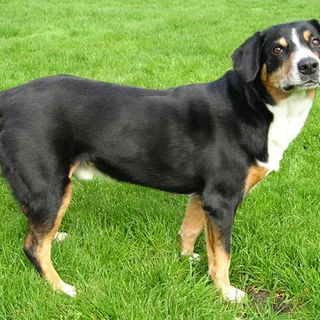
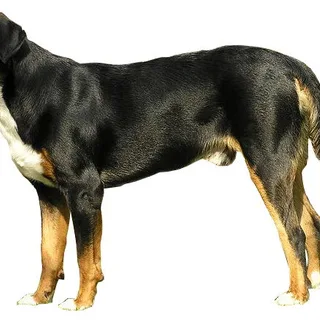
The Appenzell Cattle Dog is a medium-sized dog, robust, compact and harmoniously built, whose body fits almost into a square. Its developed musculature goes along with great mobility. Its double coat is short, firm, dense, close-lying and shiny. The tricolour coat has a black or havana base with symmetrical tan and white markings. The head remains well proportioned, with small drooping triangular ears and almond-shaped eyes with an alert expression. Its thick tail, set high and of medium length, curls into a tight ring over the croup when it is in action.
Temperament
Temperament and personality
Lively, courageous and self-confident, the Appenzell Cattle Dog has an assertive temperament. Naturally wary of strangers and very attentive to its surroundings, it effectively fulfills the role of guardian. Its herding dog heritage gives it a strong instinct for driving livestock, responsiveness and a genuine enthusiasm for work. With its family, it is cheerful, loyal and close to its owners, while retaining a certain autonomy.
Living together
Living with children and animals
Active and versatile, this dog needs long daily outings, varied exercises and tasks that stimulate its intelligence. It prefers a house with a large, well-fenced garden to an apartment. Once sufficiently exercised, it knows how to remain calm at home. It can live well with children and other animals when it has benefited from early socialization, but its vigilance and strong tendency to bark must be supervised.
Training
Training and socialization
Intelligent, attached to his owner and enthusiastic at work, the Appenzell Cattle Dog readily learns when his training starts early. A consistent method, firm without brutality, based on play, rewards and stable rules, encourages his cooperation. Socialization must be early and varied in order to moderate his distrust of strangers and to make meetings with other dogs easier. Recall, control of barking and walking on a leash deserve particular attention.
Budget
Appenzeller Sennenhund price & budget
The price of a puppy depends in particular on the quality of the lineage, the reputation of the breeding kennel, the health tests carried out on the parents and the dog's intended purpose. The relative rarity of the breed in France can also influence the price and waiting times.
View cost breakdownHealth
Health at a glance
With a solid constitution, the Appenzell Cattle Dog generally enjoys good resilience and does not present any particular genetic problem reported as a major characteristic of the breed. Serious selection, regular veterinary follow-up, suitable activity and a balanced diet nevertheless remain essential to preserve its health.
Prevention & watch pointsDiet
Feed it well
Its diet must cover the needs of a medium-sized, muscular and active dog, without providing excess energy. The ration depends on age, weight, body condition, neutering and the actual level of exercise.
Our feeding adviceDid you know?
Anecdotes and popularity
The Appenzell Cattle Dog is one of the four Swiss cattle dog breeds, alongside the Greater Swiss Mountain Dog, the Bernese Mountain Dog and the Entlebuch Cattle Dog. It is also called Appenzell Cattle Dog, Appenzell herding dog or Appenzeller Sennenhund. Its tail carried in a tight ring, sometimes nicknamed post horn, is one of its distinctive signs. Historically used to drive and guard herds, it remains a versatile working dog.