Origins
Where does it come from?
An old French breed attested at least since the 16th century, the Basset Fauve de Bretagne descends from the Griffon Fauve de Bretagne. Highly appreciated by Breton hunters in the 19th century, it narrowly escaped extinction after the Second World War. Marcel Paumbrun played a decisive role in its preservation, with contributions attributed to the Basset Vendéen and the wire-haired Dachshund. The breed then spread throughout France from the 1970s onward, notably thanks to its qualities for rabbit hunting. The Fédération Cynologique Internationale recognized it definitively on 30 October 1963 under number 36, in group 6.
Appearance
What does it look like?
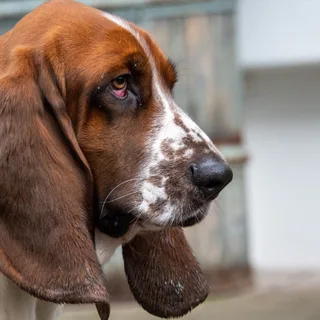
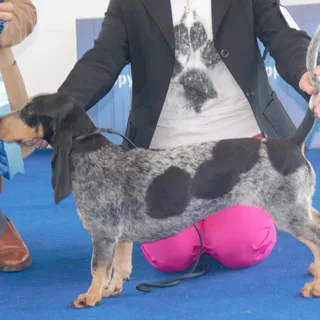
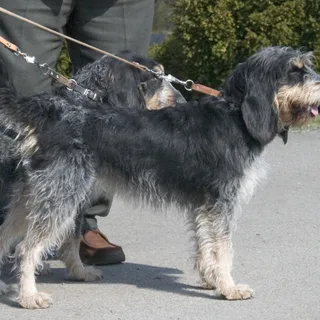
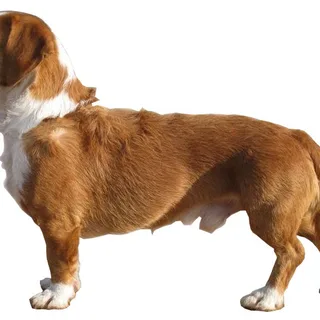
The Basset Fauve de Bretagne is a compact, stocky dog and fairly low on legs, without excessive heaviness. Its skull is elongated, its stop more pronounced than that of the Griffon Fauve de Bretagne and its muzzle slightly tapered. Its dark brown eyes express liveliness, while its drooping ears end in a point and are turned inward. The back is short and broad, the loin muscular and the chest high. Its tail, thick at the base then tapering, is carried in a sickle at rest and above the topline in action. Its short, dry and very harsh coat is neither woolly nor curly. The coat ranges from golden wheaten to brick red; a small white star on the chest and a few scattered black hairs may be accepted.
Temperament
Temperament and personality
Lively, courageous and straightforward, the Basset Fauve de Bretagne combines a strong hunting instinct with a balanced temperament at home. He is attached to his owner, affectionate, playful and generally sociable with children, visitors and his fellow dogs. Docile without being devoid of character, he can show determination when a trail awakens his scenting ability. He is not naturally aggressive and adapts well to his environment when his needs for outings and stimulation are respected.
Living together
Living with children and animals
On a daily basis, this dog enjoys family life and readily seeks interactions, games and walks. Its energy remains moderate to sustained depending on the individual and its activity, but its past as a scenthound requires regular outings and opportunities to sniff. A house with a well-fenced garden suits it particularly well; the garden does not, however, replace walks. In an apartment, it may lack space and must benefit from a very regular outing routine. Its chase instinct calls for caution with small animals and during off-leash walks.
Training
Training and socialization
Education must start early and combine gentleness, consistency and calm firmness. Intelligent and rather docile, the Basset Fauve de Bretagne learns well when sessions are short, varied and rewarded. Recall is a priority learning task because of its scenting ability and hunting instinct; it must be worked on progressively in safe places. Early socialization with people, dogs and other animals encourages its naturally sociable nature. Harsh methods are counter-productive with this sensitive but willing dog.
Budget
Basset Fauve de Bretagne price & budget
The purchase price depends on registration with the LOF, the reputation of the kennel, the quality of the selection, the health screenings of the breeding dogs and the puppy’s intended purpose. Local rarity and socialization costs can also make the price vary. The initial cost represents only part of the budget to plan for over the dog’s entire life.
View cost breakdownHealth
Health at a glance
The Basset Fauve de Bretagne is renowned for its solid build and hardiness. No major hereditary pathology is described as systematic in the breed, but regular veterinary monitoring remains essential. The shape of its ears promotes ear problems and certain lines must be subject to ophthalmological vigilance. Its low silhouette also justifies limiting excess weight and repeated traumatic exertion.
Prevention & watch pointsDiet
Feed it well
Rustic and not very demanding, the Basset Fauve de Bretagne needs a complete, digestible diet adapted to its age, weight, physiological status and activity. Quality and energy density matter more than the type of presentation. A well-adjusted ration maintains its musculature without promoting overweight.
Our feeding adviceDid you know?
Anecdotes and popularity
The Basset Fauve de Bretagne has distinguished itself in several French Cups on rabbit, a discipline that highlights its nose, its tenacity and its ability to work on difficult terrain. Despite its popularity in its country of origin, it remains relatively rare outside France. Its look of a small basset should not make one forget that it comes from a true line of scenthounds and that it remains capable of fine endurance in the field.