A menu for every age
Needs change over time
Kitten : Choose a complete growth food and divide the ration into several small meals to support development without overloading digestion.
Adult : Adjust the ration to actual activity and maintain a portion of wet food to promote hydration.
Senior : Closely monitor weight, appetite and urinary comfort, and ask the veterinarian if a senior formula becomes relevant.
Which food?
Kibble, wet food, or home-cooked diet?
A complete premium diet adapted to the cat’s age, activity level and physiological status should be preferred. Good-quality kibble can form the basis of the ration, supplemented with wet meals several times a week to support hydration and urinary comfort.
Amounts
How much should you give?
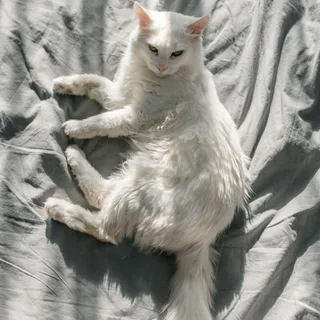
Quantities must be adjusted according to the cat’s weight, age, neutering/spaying status and actual activity level. For this rather calm cat, it is better to avoid free-feeding if weight gain becomes a risk.
| Weight | Daily amount | Meals/day |
|---|---|---|
| 4 - 5 kg | 64 - 92 g | 2 |
| 5 - 6 kg | 76 - 108 g | 2 |
| 6 - 7 kg | 88 - 124 g | 2 |
Change
Managing the food transition
Any change in diet must be carried out gradually over several days in order to avoid digestive upsets and to limit refusals. A slow transition is all the more useful in a cat attached to its eating habits.
Hydration
Water: do not overlook it
Good hydration is essential, notably for urinary comfort. Clean, fresh water must remain available at all times, and many cats drink better with several water points or a fountain.
Little extras
Treats, in moderation
Treats should remain occasional and be included in the daily ration. They can be useful for play, enrichment or learning, but excess quickly promotes overweight in a cat that does not expend much energy.
Good habits
For a top-notch bowl
- Leave fresh water available at all times.
- Split the ration if the cat often asks for food or eats too quickly.
- Weigh the ration regularly to avoid excess.
Never give
As with other cats, chocolate, onion, garlic, grapes, alcohol, caffeine, cooked bones and very fatty or salty foods should be avoided, as they can cause digestive, neurological, kidney disorders or sometimes severe poisoning.