Origins
Where does it come from?
The Rough Collie originates from the sheepdogs of the British Isles, in particular from Scotland, where it was long used for driving and guarding flocks. The breed is said to have been shaped from local dogs and lines introduced earlier into the territory. Its refined silhouette and its abundant coat then made it very popular in dog shows from the second half of the 19th century. In France, it appeared at the end of the 19th century and its image spread widely in the 20th century. The Fédération Cynologique Internationale officially recognized the breed in 1955.
Appearance
What does it look like?
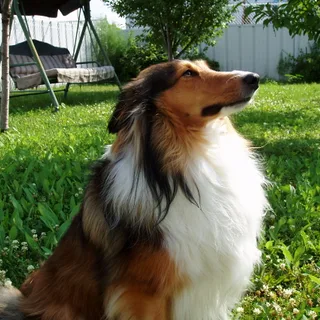
The Rough Collie is a medium-sized dog, slightly longer than tall, built harmoniously and without heaviness. Its wedge-shaped head, its almond-shaped gaze with a gentle and intelligent expression, as well as its semi-erect ears give it a very characteristic appearance. Its topcoat is straight and fairly harsh, lying over a very dense undercoat, with a well-furnished mane and frill. The coat can be sable and white, tricolor or blue merle with white markings more or less extensive.
Temperament
Temperament and personality
The Rough Collie is a kind, sensitive dog and very close to its family group. It is generally gentle with children, sociable with those close to it and not very inclined to aggression. Its herding dog temperament makes it vigilant and protective without being harsh. It may be reserved or a little shy with strangers, but overall it remains balanced, cheerful and eager to please.
Living together
Living with children and other pets
On a daily basis, the Rough Collie appreciates company and does not cope well with a life that is too lacking in interactions. He knows how to be calm at home if his needs for outings and stimulation are met, but he retains a real core of an active dog that likes to walk, run and take part in family activities. He can live in an apartment with regular walks, even if an environment with a garden often suits him better.
Training
Training and socialization
The Rough Collie benefits from being trained and socialized early. Its intelligence, sensitivity and desire to cooperate make learning easier, provided that a consistent, calm and positive method is favored. Training that is too harsh could cause it to shut down, whereas a clear framework, varied exercises and good socialization help it become a very reliable companion.
Budget
Price and budget for the Rough Collie
The purchase price of the Rough Collie varies according to the quality of the bloodlines, the seriousness of the breeding, the tests carried out on the breeding dogs and the puppy’s intended purpose. It is better to favor a transparent and well-monitored breeding kennel than an abnormally low offer.
See cost breakdownHealth
Health at a glance
The Rough Collie is overall a rather robust dog, well protected against cold and bad weather by its double coat. Like other dogs of this size, it nevertheless has certain predispositions that must be known, notably at the orthopedic and ocular level. Serious veterinary follow-up, rigorous breeding selection and good hygiene of life help to limit the risks.
Prevention and things to watch forNutrition
Feeding your pet well
The diet of the Rough Collie must support both its activity, the quality of its coat and the maintenance of a stable weight. A complete and highly digestible food is to be preferred, with intakes adjusted according to age, exercise level and body condition.
Our feeding adviceDid you know?
Fun facts and popularity
The Rough Collie is closely associated with the character Lassie, who greatly helped to popularize the breed throughout the world. This fame has lastingly established the image of a family dog, elegant and faithful. Despite this celebrity, it retains real herding abilities and a working temperament that need to be taken into account in its daily life.