Origins
Where does it come from?
The precise origins of the Russian Blue remain debated, but most sources place them in the islands of the Arkhangelsk delta, in northern Russia, where its dense coat is said to have favored its adaptation to harsh winters. The breed is said to have arrived in England and Scandinavia around the 1860s, then to have been presented at London’s Crystal Palace in 1875 under the names Archangel Cat or Blue Archangel. From 1912, it was distinguished from other blue cats. Its modern development owes much to British and Scandinavian, then American breeders. In the 1970s, crosses carried out in Australia with white Siberians contributed to the appearance of the White Russian. The LOOF and other institutions recognize the blue, white and black colors. The Nebelung is the semi-longhaired variety related to the Russian Blue.
Appearance
What does it look like?
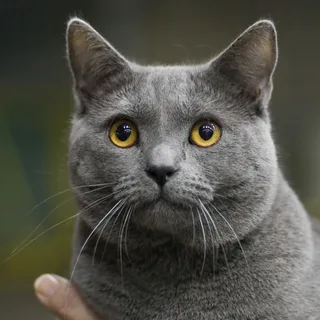
The Russian Blue has a semi-foreign body, slender and elegant, fitting into a rectangle, with a developed bone structure and musculature without heaviness. Its neck is clear and strong. Its broad head forms a triangle, with a short muzzle with rounded contours and a charcoal gray nose. Its large ears are wide at the base and set high. Its eyes, large, well-spaced and walnut-shaped, are an intense green. The tail is strong at the base then gradually tapers. Its short, double, fine and soft coat lies on a dense undercoat. The coat is blue over the whole body, with a sheen enhanced by the silvered tips of the guard hairs. The female generally weighs 2 to 3 kg and the male 3 to 5 kg; both measure about 30 cm.
Temperament
Temperament and personality
Calm, discreet and deeply attached to its human, the Russian Blue is affectionate without constantly seeking attention. It takes time to grant its trust and willingly remains reserved with strangers. Once reassured, it shows great loyalty. Curious and playful without being hyperactive, it enjoys regular interactions in a peaceful atmosphere.
Living together
Living with children and animals
The Russian Blue seeks the presence of its owner while maintaining real autonomy. It likes chasing games, objects to catch, hiding places and observation posts near a window. Not very vocal, it prefers a stable daily routine and a calm environment. It lives very well in an apartment if play and rest areas, a scratching post and a cat tree are provided. Its reserve toward strangers requires respecting its pace during introductions.
Training
Training and socialization
A gentle, gradual and consistent approach suits this sensitive and reserved cat. Learning related to the scratching post, transport, care and house rules benefits from being associated with rewards and short sessions. Sudden constraints should be avoided and it should be given time to observe before interacting.
Budget
Russian Blue price & budget
The purchase price varies depending on the lineage, the pedigree, the reputation of the breeding cattery, compliance with the standard and the cat’s intended purpose. The reference sheet also indicates an annual maintenance cost that varies depending on diet, care and lifestyle.
View cost breakdownHealth
Health at a glance
The Russian Blue is considered robust and no particular predisposition is reported by the reference sheet. However, it may be prone to being overweight. Like any cat, it must benefit from regular veterinary follow-up, an appropriate diet, good hygiene and up-to-date vaccinations according to its lifestyle, notably against typhus, coryza, feline leukemia and, when necessary, rabies.
Prevention & watch pointsDiet
Feed it well
Its diet must remain balanced, complete and adapted to its age, its activity and its body condition. It must provide quality proteins, fats without excess, as well as the necessary vitamins and minerals, while limiting the risk of overweight.
Our feeding adviceDid you know?
Anecdotes and popularity
The Russian Blue has also been called Archangel Cat, Blue Archangel and Russian Blue. The reference sheet also mentions Russian and Nebelung among its other names, while specifying that the Nebelung corresponds to the semi-long-haired variety. Its vocal discretion and the silvery reflections of its coat are among its most appreciated distinctive features.