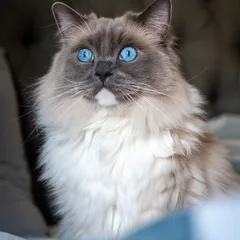
Breed comparison
Ragdoll or Birman: Which breed should you choose?
Ragdoll and Birman are two cat breeds often compared by prospective owners. Here’s a point-by-point comparison to help you decide: size, temperament, purchase price, monthly budget, and compatibility with your lifestyle.

+6

+10
Key takeaways
- Ragdoll and Birman are a similar size (3–9 kg).
- Birman costs less to buy: €400 – €1,400 compared with €600 – €2,500 for Ragdoll.
- The monthly budget is similar for both breeds: about €95 per month.
- Ragdoll needs less daily activity (2/5 compared with 3/5 for Birman).
- Birman scores higher for “Families and children”: 5/5 compared with 4/5 for Ragdoll.
- For “Apartment living,” both breeds are tied (5/5).
- For “First-time owners,” both breeds are tied (5/5).
- Both breeds have a similar life expectancy: 12–17 years.
Our verdict
Choose Ragdoll if you’re looking for…
- Calm families: Its gentleness and patience are well suited to calm households that respect its pace.
- Apartment living: It adapts very well to a comfortable and secure indoor home.
- First-time adopters: Its stable and affectionate temperament often makes life easier with a first purebred cat.
Choose Birman if you’re looking for…
- Families with respectful children: His gentleness and patience generally make him a good family companion.
- People present on a daily basis: He appreciates a close relationship and benefits from a home where he receives regular attention.
- Apartment living: His natural calm suits a properly arranged indoor home.
Detailed comparison
| General information | ||
|---|---|---|
| Origin | United States | France |
| Build | Large | Medium |
| Height at the withers | 30–38 cm | 22–30 cm |
| Weight | 3–9 kg | 4–7 kg |
| Coat | Semi-long, fine | Semi-long, silky |
| Life expectancy | 12–17 years | 14–17 years |
| Average price | €600 – €2,500 | €400 – €1,400 |
| Monthly budget | ≈ €95 | ≈ €95 |
| Compatibility | ||
| Families and children | Very good | Excellent |
| Daily exercise needs | Low | Moderate |
| Apartment living | Excellent | Excellent |
| First-time owners | Excellent | Excellent |
| Other pets | Very good | Very good |
| Tolerance of being alone | Limited | Limited |
| Vocalization | Quiet | Quiet |
| Strengths and weaknesses | ||
|
|