Origins
Where does it come from?
A breed of German origin, the Pudelpointer was developed in the 19th century from crosses between Poodles and various Pointers, with the aim of obtaining a versatile pointing dog, effective on various terrains and capable of working equally well on the plains as in the forest or in wet areas. The breed has been the subject of ongoing selection, notably to limit certain defects such as hip dysplasia and epilepsy. It was definitively recognized by the FCI in 1959.
Appearance
What does it look like?
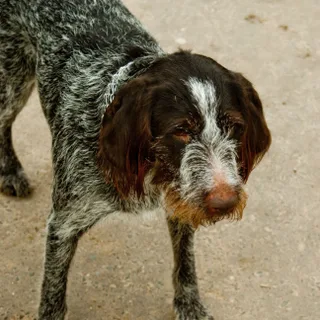
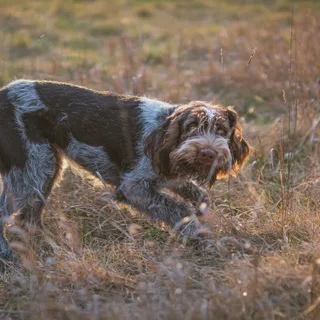
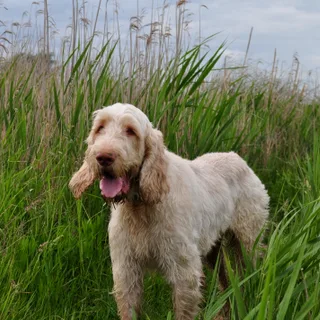
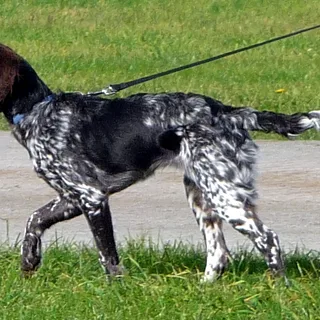
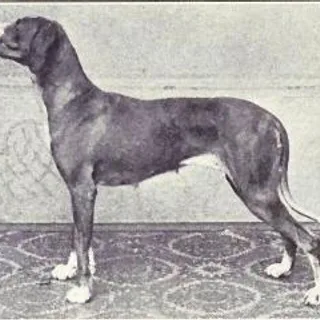
The Pudelpointer is a medium-sized dog, of solid and rather heavy build, fitting into a rectangle. Its back is short and firm, its chest broad and well let down, and its overall appearance gives an impression of functional power without excessive heaviness. The head is well proportioned, with a broad and flat skull, a pronounced stop, expressive dark amber eyes and high-set ears. The coat is medium-long, harsh, dense and lying close to the body, with a thick undercoat, a beard and a topknot on the head. The coat color is generally brown, dead leaf or black, sometimes with small white markings tolerated.
Temperament
Temperament and personality
The Pudelpointer is a versatile hunting dog, determined and courageous at work, but with an overall balanced temperament in everyday life. It is pleasant to live with, close to its owner without being overly demonstrative, and retains good stability of character. Its hunting instinct remains pronounced, which makes it a serious, willing companion naturally oriented toward activity.
Living together
Living with children and animals
On a daily basis, the Pudelpointer likes to move, explore and work. He enjoys long outings, natural environments and activities that call on his sense of smell, his endurance and his concentration. Although he can be calm at home after exercise, he copes poorly with a life that is too sedentary. He clearly prefers wide open spaces to strictly urban life and thrives better with active owners.
Training
Training and socialization
The Pudelpointer’s training must start early, in particular recall, given its hunting instinct. It responds better to firm, consistent and fair handling, based on encouragement and rewards rather than brutality. Its sensitivity and relative independence require an involved, patient and consistent handler, capable of channeling its abilities without breaking its drive.
Budget
Pudelpointer price & budget
The Pudelpointer is an uncommon breed, often sought after for its hunting abilities and versatility. Its price depends mainly on the rarity of litters, the seriousness of the selection, and the work carried out by the breeder on health and functional qualities.
View cost breakdownHealth
Health at a glance
The Pudelpointer is overall a robust dog, with solid health and well equipped to work in cold or wet weather. As with many medium-sized working breeds, a few hereditary or functional conditions nevertheless deserve regular monitoring, particularly on the joint, neurological and ear levels.
Prevention & watch pointsDiet
Feed it well
The Pudelpointer needs a high-quality, balanced diet adapted to its age, size, activity level and lifestyle. An active dog, it benefits from a well-adjusted ration, sufficient to support endurance without promoting overweight.
Our feeding adviceDid you know?
Anecdotes and popularity
The name Pudelpointer directly recalls its origins, between the Poodle, called Pudel in German, and the Pointer. This breed was designed to bring together qualities of retrieving, nose, pointing and ease on varied terrain, including wet ground. Today it remains mainly appreciated for its working abilities and remains relatively rare outside specialized hunting circles.