Origins
Where does it come from?
The Newfoundland owes its name to the Canadian island of Newfoundland, where it developed from local dogs and ancient European contributions, probably influenced by large dogs introduced long before the massive arrival of fishermen. From the 16th century, it accompanied sailors and fishermen, pulled loads, retrieved nets and quickly stood out for its strength, endurance and remarkable abilities in the water. Used later as a draft, guard, herding, hunting and later water rescue dog, it saw its standard take shape in the 20th century, the current standard being under Canadian responsibility.
Appearance
What does it look like?
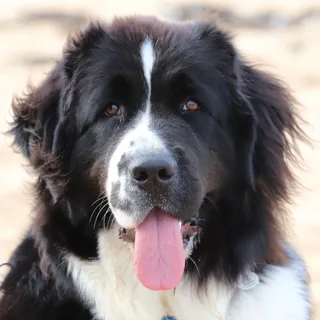
The Newfoundland is a very large dog with a solid body, broad and powerfully built, with a deep chest, a broad back and muscular loins. Its head is massive, the muzzle rather short and square, the eyes dark brown, the ears small and triangular, and the tail strong at the base. Its double coat, medium-length, dense, flat and slightly oily, combined with a thick undercoat, offers it excellent protection against cold and water. The accepted coats are black, brown and black and white.
Temperament
Temperament and personality
The Newfoundland is a gentle, calm, loyal and very affectionate dog, renowned for its patience and composure. Its size is impressive, but it is not aggressive and is generally docile, protective without excess and very attached to its family. It particularly appreciates the presence of children, often cohabits well with other animals and retains a real working ability combined with remarkable courage.
Living together
Living with children and animals
On a daily basis, the Newfoundland likes to be close to its family and copes poorly with prolonged solitude. It can remain calm at home if it benefits from regular outings, but it needs daily exercise and loves swimming, an activity in which it excels thanks to its power and its webbed feet. Playful without being nervous, it prefers useful activities, outdoor walks and environments where it can expend itself calmly.
Training
Training and socialization
The education of the Newfoundland must be early, consistent and positive, notably because of its size and strength in adulthood. It is an intelligent and sensitive dog, which responds better to patience, encouragement and clear rules than to constraint. Its youth can be boisterous, hence the importance of learning very early leash walking, self-control and good manners, while respecting its physical maturity.
Budget
Newfoundland price & budget
The purchase price of a Newfoundland varies mainly depending on the quality of the bloodline, the seriousness of the breeding, the health tests carried out, compliance with the standard and the breeder's reputation. Its large size also implies a substantial daily maintenance budget.
View cost breakdownHealth
Health at a glance
The Newfoundland is overall a robust dog for its size, but its large stature requires particular vigilance regarding the locomotor system, the heart and the risk of gastric torsion. Its thick coat protects it well from the cold, but makes it more sensitive to heat. Like many water dogs, its ears must also be monitored regularly.
Prevention & watch pointsDiet
Feed it well
The diet of the Newfoundland must be planned for a giant dog, with a good-quality ration suited to its age, its activity level and its joint sensitivity. Regular meals, permanent access to water and monitoring of body condition are essential throughout its life.
Our feeding adviceDid you know?
Anecdotes and popularity
The Newfoundland is famous for its natural abilities in sea rescue. Bilbo, a British rescue dog, was publicized for several interventions with swimmers in difficulty. Seaman, another famous representative of the breed, accompanied the Lewis and Clark expedition in North America. The breed is also known for its webbed feet and its ability to work in cold water.