Origins
Where does it come from?
The English Foxhound comes from a long British tradition of selection for hunting with hounds, notably fox hunting carried out by riders. Its kennels and genealogies have been tracked with precision for more than two centuries by the English Foxhound Association, whose register dates back to before 1800. This long-standing traceability has made it possible to establish a powerful, enduring scenthound suited to pack work. The breed, also called English Foxhound, bears FCI number 159, which has recognized it since 1955 within group 6. It is also recognized by the UKC, the AKC, the ANKC, the CKC, the British Kennel Club and the NZKC.
Appearance
What does it look like?
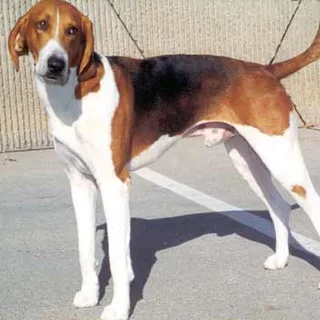
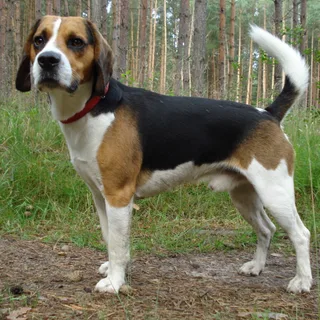
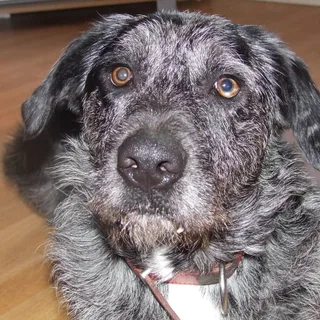
The English Foxhound is a large, powerful hunting dog, harmonious and well proportioned, without any impression of heaviness. Its long head has a flat and moderately broad skull, a slightly marked stop, a long and square muzzle, large nostrils and strong jaws with a scissor bite. Its medium eyes, hazel or brown, express liveliness, while its ears are set high and pendant. The back is broad and level, the loin strong and slightly convex, the chest well let down and the ribs well sprung. Its tail, set high, is carried upright without curling over the back. Its short and dense coat withstands bad weather well. All shades of colour and markings are permitted. Its fluid and free movement reflects its great endurance.
Temperament
Temperament and personality
A par force hunting dog, the English Foxhound is energetic, enduring and endowed with a very marked pursuit instinct. In everyday life, it generally shows itself friendly, pleasant and devoid of aggressiveness. Its affection is measured, its intelligence correct and its temperament more turned toward action than toward guarding. Sociable when it has been properly familiarized, it can live with children and other animals under supervision, but its hunting instinct must always be taken into account.
Living together
Living with children and animals
Very active, the English Foxhound needs plenty of space, freedom of movement and long, frequent outings. Simple hygienic walks are not enough for its balance. It enjoys endurance activities, tracking and exercises that make use of its sense of smell. Apartment living suits it very little and the ideal environment remains a house with a large, perfectly fenced plot of land. In the city, its adaptation requires significant availability, sustained daily activity and rigorous management of outings. Not very inclined to guarding, it can however be vocal.
Training
Training and socialization
The education of the English Foxhound must be firm, consistent and respectful, without brutality. Its energy, its autonomy at work and its powerful hunting instinct make recall training a priority from the youngest age. Short, regular and motivating sessions give better results than repetitive work. Early socialization with people, dogs and other animals helps to channel its pack dog behavior. Even well trained, it must be walked on a long line or in a secure area when recall is not totally reliable.
Budget
English Foxhound price & budget
The purchase price varies depending on the lineage, the reputation of the breeding kennel, the quality of health monitoring, the dog's intended use and the guarantees provided. The ongoing budget must also take into account a diet suited to a large active dog and preventive care.
View cost breakdownHealth
Health at a glance
The English Foxhound is generally sturdy and resilient, with a dense coat that protects it properly from bad weather. However, the breed is not free from hereditary or acquired risks, notably renal amyloidosis, deafness and hip dysplasia. A litter usually has 5 to 7 puppies. This dog is not considered hypoallergenic.
Prevention & watch pointsDiet
Feed it well
The English Foxhound needs a complete, balanced, good-quality diet, adapted to its size, its age and above all to its level of physical activity. Its needs can vary greatly depending on whether it leads a life as an active companion or does endurance work.
Our feeding adviceDid you know?
Anecdotes and popularity
The genealogical tracking of the English Foxhound is among the oldest and most rigorous in the British canine world, with a registry dating back to before 1800. Traditionally, this dog accompanied hunters on horseback at a fast pace and worked in a pack, which explains its endurance, canine sociability and carrying voice. The breed is known internationally under the name English Foxhound and benefits from cynological recognition in several countries.