Origins
Where does it come from?
The Harrier is an ancient British scenthound whose origins date back to the Middle Ages. Selected for hare hunting, then sometimes for fox, it long worked in a pack and built a reputation as an enduring, diligent and very effective dog on the trail. Its numbers remain modest today, including in the United Kingdom. The breed was definitively recognized by the FCI in 1974.
Appearance
What does it look like?
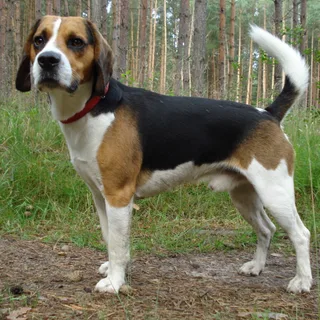
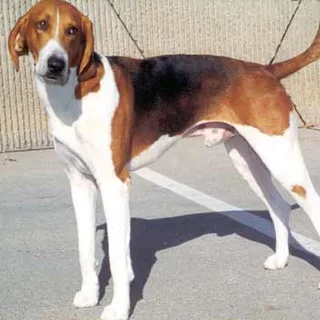
The Harrier is a scenthound of harmonious build, solid without heaviness, giving an impression of lightness and endurance. Its silhouette is well proportioned, with a straight and muscular back, a fairly high chest, a long neck, an expressive head and high-set V-shaped ears. The coat is short, smooth and flat. The coat is based on a white background marked with black, orange or tan, tricolour subjects being frequent.
Temperament
Temperament and personality
The Harrier has a balanced, friendly temperament and is pleasant to live with. Affectionate with its family, it generally gets along well with children and is sociable with its fellow dogs. Its hunting instinct nevertheless remains very pronounced, which explains its interest in trails, its taste for movement and a certain tendency to follow scents with determination.
Living together
Living with children and animals
On a daily basis, the Harrier is a very active dog that copes poorly with prolonged inactivity and an overly sedentary lifestyle. He enjoys long outings, running and activities that make use of his sense of smell. He likes company and copes poorly with repeated isolation. Outdoors, his nose can easily take over, hence the importance of a secure environment and a well-trained recall.
Training
Training and socialization
The Harrier’s training must start early, especially recall and the management of distractions. This dog learns properly, but its scenthound temperament and its attraction to trails can make it less obedient than a companion dog very oriented toward its owner. A consistent, patient, firm without brutality method, based on motivation, gives better results.
Budget
Harrier price & budget
The purchase price of the Harrier varies depending on the quality of the lineage, the reputation of the breeding kennel, the dog's intended purpose and the rarity of the breed. Its overall cost must always be considered along with routine maintenance costs and any potential health expenses.
View cost breakdownHealth
Health at a glance
The Harrier is overall a hardy and solid dog. Its selection as a working dog has given it good endurance and a generally robust constitution, even if certain orthopedic, digestive or endocrine conditions deserve measured vigilance.
Prevention & watch pointsDiet
Feed it well
The Harrier needs a complete, good-quality diet, adapted to its age, its weight and above all to its often high activity level. A hunting or sporting dog will not have exactly the same needs as an individual leading a more family-oriented life.
Our feeding adviceDid you know?
Anecdotes and popularity
The Harrier is sometimes nicknamed Harehound in the English-speaking world. Despite its name being close to the Beagle-Harrier, it is indeed a distinct breed. Rare outside certain circles of enthusiasts, it remains above all appreciated for its qualities as an enduring hunting dog, its keen nose and its effective work in a pack.