Origins
Where does it come from?
The Egyptian Mau is among the oldest known feline breeds. Its image already appears in ancient Egypt, where it held an important symbolic place and also accompanied daily life by helping to limit rodents. The breed nearly disappeared during the 20th century, notably after World War II, before being revived in Italy and then developed in the United States thanks to the breeding work undertaken around the cats gathered by Princess Natalia Troubetskoy. The Egyptian Mau then spread more widely in Europe, including France.
Appearance
What does it look like?
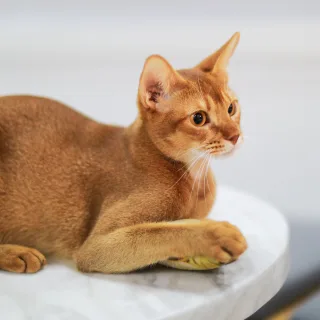
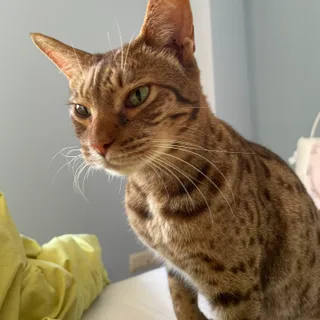
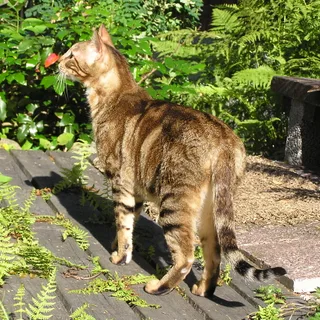
The Egyptian Mau is a medium-sized cat, elegant, muscular and particularly agile. Its body remains harmonious, with a silhouette intermediate between the oriental type and the European cat. Its hind legs, a little longer, promote powerful leaps and great speed. Its head, slightly triangular and rounded, has large green almond-shaped eyes, large well-proportioned ears and a forehead often marked with an M-shaped pattern. Its short coat shows a natural spotted tabby pattern, with recognized colors such as silver, bronze or smoke.
Temperament
Temperament and personality
The Egyptian Mau combines independence, sensitivity and attachment to its home. Affectionate with those close to it, it appreciates calm moments and quality interactions, while keeping a vigilant temperament. It can be reserved with strangers, but it generally develops a lovely bond with its family.
Living together
Living with children and other pets
He is a playful, athletic cat and a hunter at heart, who needs daily stimulation to stay balanced. He likes to climb, observe and expend energy, which makes him more comfortable in an enriched environment. With respectful children, he willingly joins in play. On the other hand, boredom and a sedentary lifestyle do not suit him well and can promote weight gain.
Training
Training and socialization
The Egyptian Mau responds well to gentle, consistent and regular training. It learns more easily when routines are stable and when motivation comes through play, reward and positive interactions. It is preferable to respect its sensitivity and its need to observe before imposing new situations on it or the presence of strangers.
Budget
Price and budget for the Egyptian Mau
The price of an Egyptian Mau varies depending on the quality of the lineage, the reputation of the cattery, the sex, conformity to the standard and the kitten’s intended purpose. Serious selection and well-managed breeding often justify a higher price.
See cost breakdownHealth
Health at a glance
The Egyptian Mau generally enjoys fairly robust health. No specifically recognized genetic disease is consistently highlighted, but this does not exempt from serious veterinary follow-up. Like many active cats sometimes living more indoors, it is above all necessary to prevent overweight, monitor oral and dental condition, and keep vaccinations and antiparasitic protection up to date.
Prevention and things to watch forNutrition
Feeding your pet well
The Egyptian Mau needs a complete, good-quality diet to maintain its muscle mass without promoting weight gain. Its diet must remain adapted to its age, its physiological status and its activity level.
Our feeding adviceDid you know?
Fun facts and popularity
The Egyptian Mau is often presented as one of the very rare breeds of naturally spotted domestic cats. Its name simply means cat in Egyptian. Its athletic build, its speed and the M-shaped mark on the forehead further reinforce its image as an ancient and distinctive cat.