Origins
Where does it come from?
The Drever descends from the Westphalian Basset, introduced into Sweden at the beginning of the 20th century. The name Drever was officially adopted in 1947 to designate this Swedish version, slightly taller at the withers. Highly valued as a tracking and scenthound dog, it remains rare outside Sweden. The breed was definitively recognized by the FCI on 4 January 1955 and its current official standard was published on 21 February 2006.
Appearance
What does it look like?
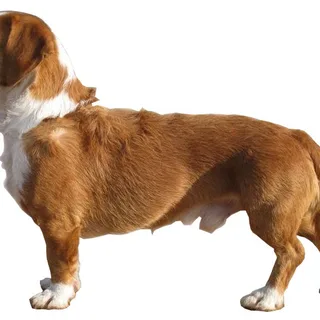
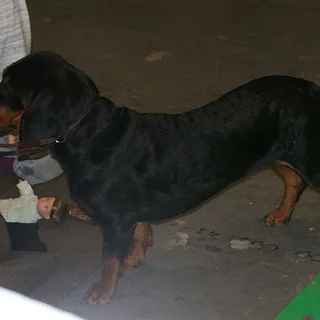
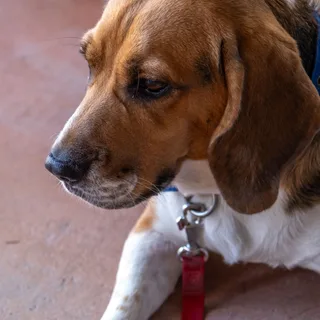
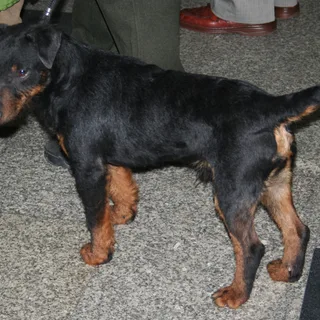
The Drever is a scenthound of the basset type, low on legs, with an elongated body, strong and well muscled. Its topline is straight, its chest well developed and its limbs show a solid bone structure. Its head is rather long, its ears are set low, hanging and lying close to the cheeks, and its tail is long and strong. Its coat is straight, short, lying close and of harsh texture, with all colours patched with clearly defined white.
Temperament
Temperament and personality
The Drever is a well-balanced dog, full of spirit, affectionate and very attached to its owner. It is neither aggressive nor fearful and retains a true scent hound temperament. Used for hunting different game, it also shows a good presence in the family, without being naturally inclined to guarding.
Living together
Living with children and animals
On a daily basis, the Drever needs activity to stay stimulated and fulfilled. He enjoys regular outings, scent trails and activities that engage his sense of smell. He can adapt to several living environments, but he is better suited to an active household than to a very sedentary lifestyle.
Training
Training and socialization
His training must combine firmness, gentleness and consistency. High-quality early socialization is important, as is teaching recall as early as possible. The Drever responds well to a consistent framework, with short, regular sessions suited to his strong-willed temperament.
Budget
Drever price & budget
The purchase price of a Drever varies depending on the origin of the bloodline, the reputation of the breeding kennel and the availability of the breed, which remains uncommon outside Sweden. It is important to favor a reputable breeder focusing on health, socialization and traceability.
View cost breakdownHealth
Health at a glance
The Drever is overall a robust and resilient dog. When it benefits from serious veterinary follow-up, suitable activity and well-controlled weight, it does not present any marked general fragility.
Prevention & watch pointsDiet
Feed it well
The Drever needs a quality diet, adapted to its age, its size and its level of exercise. Its daily ration must remain consistent with its activity to support its condition without promoting overweight.
Our feeding adviceDid you know?
Anecdotes and popularity
The Drever is also known as the Swedish Basset or Swedish Dachsbracke. Although it is highly appreciated in Sweden for hunting, it still remains rare in many other countries. Its low, elongated silhouette recalls other bassets, but the breed has a very distinct Swedish identity.