Cats

Curly Coated Retriever: temperament, price, health, and breeders

United Kingdom

Also called the Curly-Coated Retriever, this large British retriever combines strength, elegance and energy.

SizeLargeLife expectancy8–12 yearsBudget≈ 138 €/monthKitten900–1,500 €

Right choice?

Is it right for you?

Family & childrenGood
Daily activity requiredVery high
Apartment livingFairly good
First-time ownerGood
Other petsGood
Tolerance for being aloneGood
Guarding instinctLimited

Pros & Cons

  • Intelligent and hardworking : He learns willingly and invests himself with enthusiasm in the activities offered.
  • Robust : His solid build allows him to lead an active life when he is properly cared for.
  • Balanced : He combines confidence, reliability and friendliness with measured independence.
  • Excellent retriever : His hunting instinct and his abilities in retrieving game are particularly well developed.
  • Very high need for activity : Long outings and daily activities are essential to his balance.
  • Independent temperament : His training requires consistency and an approach that is both firm and gentle.
  • Apartment living not very suitable : He thrives better when he has space and regular opportunities to run.
  • Joint and eye vigilance : Predispositions to dysplasia and entropion justify careful monitoring.

Who is it for?

Ideal for

  • Active households : Its high energy suits people who are available for long daily outings.
  • Dog activity enthusiasts : Retrieving, search games and obedience work make use of its natural abilities.
  • Living in a house with a garden : A secure outdoor space makes it easier for it to expend energy, without replacing walks.

Not recommended for

  • Very sedentary people : Its high need for exercise is incompatible with a not very active daily routine.
  • Households often away : Lack of activity and stimulation can lead to boredom and undesirable behaviors.
  • Looking for a guard dog : Its protective instinct is weak and that is not its primary function.

Portrait

What does it look like?

1,75 mHuman
66 cmCurly Coated Retriever
Height at withers
62–70 cm
Weight
25–36 kg
Coat
Short, curly, tight, without undercoat
Origin
United Kingdom
Grooming
Easy grooming

Photos & videos

Discover the Curly Coated Retriever in photos and videos: coats, sizes, and the breed’s distinctive expressions.

Origins

Where does it come from?

The exact origins of the Curly Coated Retriever remain uncertain, notably regarding the crossbreeding at the origin of the breed. One theory mentions the contribution of the Newfoundland and the Irish Water Dog in its development in England. It is among the oldest varieties of retrievers, with breeding probably dating back to the 18th century. Its abilities in retrieving game quickly earned it a place in hunting. The Fédération Cynologique Internationale definitively recognized the breed on 10 December 1954.

Appearance

What does it look like?

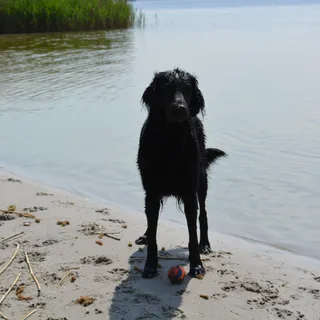
The Curly Coated Retriever is a large dog of strong and elegant build, slightly longer than tall. Its topline is horizontal, its chest well let down and its long head forms a wedge when seen in profile. The skull and the muzzle are of the same length, the stop is little marked and the strong jaws have a scissor bite. Its large oval eyes, set obliquely, match the colour of the coat. Its small ears, set slightly above the eye line, are covered with curls. Its tail continues the topline and is carried straight at its level when in action. The solid-coloured coat is black or liver brown. The short, close coat, formed of small curls, covers the whole body, without undercoat.

Temperament

Temperament and personality

The Curly Coated Retriever has a balanced temperament. Intelligent, reliable and courageous, it retains a real independence. It is friendly and full of confidence, while being able to be somewhat reserved. Its hunting instinct is pronounced and its specialty remains the retrieving of game.

Playful Intelligent

Living together

Living with children and animals

Very energetic, playful and athletic, he needs daily activity and space to express himself. Long walks once or twice a day, complemented by retrieving activities and mental stimulation, help him stay balanced. Insufficient exercise can encourage boredom and undesirable behaviors. He can live in different settings if he is sufficiently stimulated, but a house with a large garden suits his needs better than an apartment.

Training

Training and socialization

His intelligence, his enthusiasm for work and his taste for learning make his training easier. He responds best to a consistent method combining measured firmness and gentleness. Early socialization, recall, control of excitement and retrieving exercises must be worked on regularly.

Budget

Curly Coated Retriever price & budget

Uncommon breed in France: a breeder puppy often sells for between €900 and €1,500.

View cost breakdown

Health

Health at a glance

The Curly Coated Retriever is an overall robust and resilient dog. The breed nevertheless has predispositions that justify careful selection of breeding dogs and regular veterinary monitoring, notably with regard to joints and eyes.

Prevention & watch points

Diet

Feed it well

The Curly-Coated Retriever, a large athletic retriever, needs a complete diet that is sufficiently energetic on water and retrieving days, more measured at rest.

Our feeding advice

Did you know?

Anecdotes and popularity

The Curly Coated Retriever is also known in French as the Retriever with curly coat. It bears the FCI standard number 110 and belongs to group 8 of retriever dogs, flushing dogs and water dogs. A litter generally has 7 to 8 puppies according to the reference sheet.
FAQ

Frequently asked questions about Curly Coated Retriever

Everything future adopters wonder about before their companion arrives.

He can adapt to different lifestyles if he gets long outings and daily stimulation, but an apartment suits him less well than a house with a large garden.

His intelligence and enthusiasm for work are real assets, but his independence requires consistent, regular training that is balanced between firmness and gentleness.

Brushing once to twice a week is generally sufficient, with increased frequency during the two annual shedding periods. A bath can be given as needed, around three times a year.

No. Despite its curly coat and the absence of an undercoat, the breed is not considered hypoallergenic.

Ready to welcome a Curly Coated Retriever?

Find a registered, verified breeder near you, and meet your future companion with peace of mind.

View breeders