Origins
Where does it come from?
The Finnish Hound began to be developed after the creation of the Finnish Kennel Club in 1889. It descends from crosses between local dogs and various European scenthounds. A first standard was drawn up in 1932. The current Fédération Cynologique Internationale standard was published on 17 July 1997. The breed, registered under number 51 of group 6, was definitively recognized by the FCI on 8 August 1954. Outside its country of origin, Finland, it remains fairly uncommon. The breed is also called Finnish Hound, Finnish Hound or Suomenajokoira.
Appearance
What does it look like?
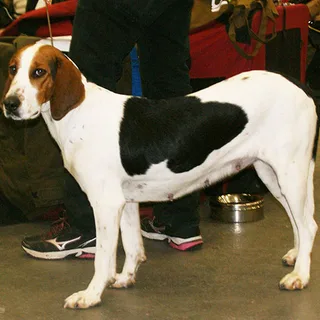
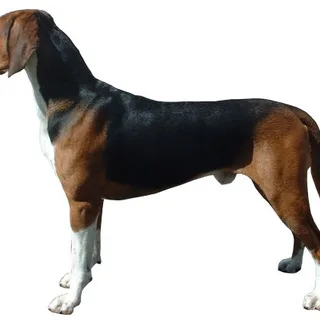
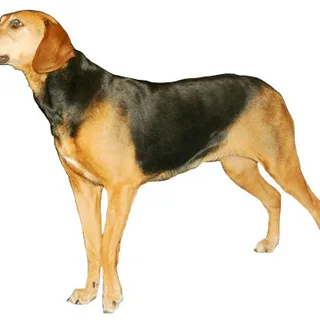
The Finnish Hound is a medium-sized hunting dog, with a body longer than it is tall, strongly built but without heaviness. Males measure from 55 to 61 cm and females from 52 to 58 cm; the indicated weight is 24 to 25 kg for both sexes. Its head is rather long, with a skull of regular width with a domed top, a slight but clearly defined stop and a well-developed black nose. Its ears are flat and drooping. Its dark brown eyes express calm. Its neck is of medium length, muscular and well defined, its back is straight and its croup long and well developed. Its tail, set low and moderately curved, is thick at the base then tapers towards its tip; it is carried up in action. The topcoat is straight, lying close, dense and harsh, with a short, dense and softer undercoat. The tricolour coat combines a black mantle, intense tan markings on the head, the lower parts of the body, the shoulders and the thighs, as well as white markings on the head, the neck, the chest, the lower parts of the limbs and the tip of the tail.
Temperament
Temperament and personality
The Finnish Hound has a calm, friendly and never aggressive temperament. It nevertheless shows remarkable energy when it practices its favorite activity, hunting.
Living together
Living with children and animals
Built for hunting, the Finnish Hound needs long daily walks. Playful and athletic, it prefers to live in the middle of or close to nature, notably in a country house or near a wooded area. It is better suited to a rural lifestyle than to an urban setting, but must in all cases be sufficiently walked and stimulated each day.
Training
Training and socialization
His training requires time and patience, because obedience is not his strong point. Once the bonds with his owner are well established, he nevertheless likes to learn and to please him.
Budget
Finnish Hound price & budget
The purchase price varies depending on the breeder and the dog's characteristics.
View cost breakdownHealth
Health at a glance
The Finnish Hound is a rustic and fairly robust dog. No predisposition to a particular disease is reported for this breed.
Prevention & watch pointsDiet
Feed it well
The Finnish Hound needs a balanced diet, adapted to its level of physical activity, its age and its size.
Our feeding adviceDid you know?
Anecdotes and popularity
The Finnish Hound is a breed whose history and standard deserve to be known before acquisition, in order to choose a breeding kennel consistent with the intended use.