Origins
Where does it come from?
The Yugoslavian Tricolour Hound shares the ancient origins of the scenthounds developed in the Balkans. It was presented at the Belgrade international dog show in June 1950. The Fédération Cynologique Internationale recognized it in 1961 under standard number 229, within group 6. Also recognized by the UKC, it remains today quite rare outside Serbia.
Appearance
What does it look like?
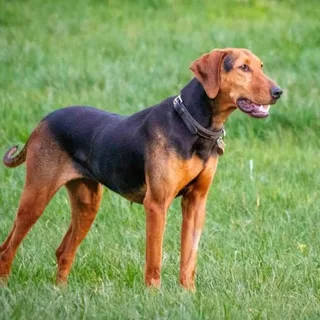
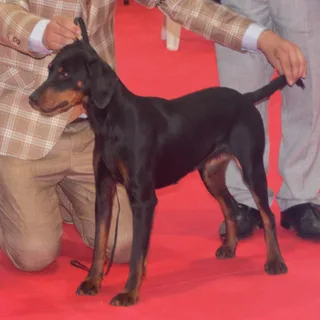
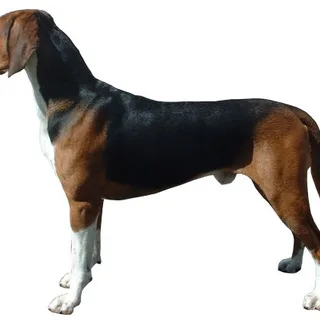
Of medium size and solidly built, this dog has a body slightly longer than tall, fitting into a rectangle. Its head is long, fine and elongated, with a slightly domed skull, a not very pronounced stop, a black nose and a wedge-shaped muzzle. Its ears, set high, are pendant and end in an oval. Its dark eyes are set obliquely and tend toward an almond shape. The back is strong and muscular, the chest solid and the tail, thick at the base, tapers toward its tip. The short, dense, shiny and rather thick coat covers a well-developed undercoat. The coat is tricolour, dominated by an intense red or reddish, with a black mantle or saddle and white markings on the muzzle, the neck and sometimes the forechest. Males measure 45 to 55 cm and females 44 to 54 cm; both sexes generally weigh 20 to 25 kg.
Temperament
Temperament and personality
It is a self-assured dog, with an assertive temperament, but friendly and very attached to its owner. When hunting, it proves lively, tenacious, determined and endowed with a very pronounced tracking instinct. It is affectionate with its family, moderately protective and sociable if its training and encounters have been properly conducted.
Living together
Living with children and animals
Active and enduring, he needs to walk and trot for long periods, regularly and over long distances. A short hygienic outing is not enough for his balance. His hunting instinct and his rather present voice must be anticipated on a daily basis. Living with children and other animals is possible with early socialization and appropriate supervision.
Training
Training and socialization
Recall training must begin very early, just like the basic commands. An early, consistent, firm education without brutality and based on positive reinforcement makes it possible to obtain a docile and pleasant companion. Its assertive temperament, its hunting instinct and its imperfect obedience require consistency, especially during outings in open environments.
Budget
Yugoslavian Tricolour Hound price & budget
The price depends on the rarity of the breed outside Serbia, the reputation of the breeding kennel, the quality of the pedigree, the screenings carried out on the parents, and the costs related to a possible trip or an import.
View cost breakdownHealth
Health at a glance
The Yugoslavian Tricolour Hound has a solid constitution and overall robust health. Its double coat provides good protection against harsh climatic conditions. No major specific predisposition is particularly reported, but the joints and ears must be subject to regular monitoring.
Prevention & watch pointsDiet
Feed it well
A balanced, high-quality diet must be adapted to the age, weight, body condition and activity level of this scenthound. Needs increase during hunting periods or sustained exercise and decrease during rest phases.
Our feeding adviceDid you know?
Anecdotes and popularity
The breed is also called Serbian Tricolour Hound and Srpski Trobojni Gonic. Its FCI standard bears number 229; it belongs to group 6 and has been recognized since 1961. It is recognized by the FCI and the UKC. A litter generally has 3 to 6 puppies. Its gait is characterized by long strides and a clear and regular trot.