Origins
Where does it come from?
The origins of the Chartreux date back to the Middle Ages, its ancestors often being described as blue cats that arrived in Europe from the Near East. The modern breed took shape in France during the 1920s, notably thanks to the work of the Léger sisters on Belle-Île-en-Mer. A precise morphological description then helped to establish its type. The Chartreux also went through a period of confusion with the blue British Shorthair, before breeders set out to preserve its own identity.
Appearance
What does it look like?
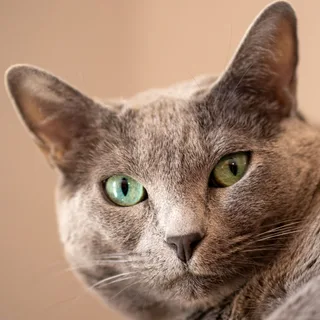
The Chartreux is a medium to large cat, solidly built, with powerful musculature and a well-developed chest. Its broad head with rounded contours has pronounced cheeks, especially in the male, as well as large yellow to orange eyes. Its coat is short, very dense, slightly woolly, with an abundant undercoat that protects well from moisture. The coat color is uniformly blue-gray, from light to slate, without marked contrast.
Temperament
Temperament and personality
The Chartreux is known for its calm, discretion and good balance. It becomes attached to its family, enjoys moments of closeness, but keeps a real independence and does not always like being approached when it does not feel like it. Intelligent, observant and adaptable, it generally gets along well with respectful children and tolerates the presence of other animals fairly well.
Living together
Living with children and other pets
On a daily basis, the Chartreux is calm, not very vocal and fairly independent. He likes to observe his environment, explore and maintain a certain freedom of movement, which explains why secure access to the outdoors is often appreciated. Indoors, he readily enjoys a cat tree, toys and regular interactions to stay active without becoming agitated.
Training
Training and socialization
The Chartreux’s education must be consistent, gentle and firm at the same time. Its sensitivity and intelligence allow it to quickly learn the habits of the home, provided that boundaries are set early and without brutality. It responds better to a stable routine, to calm encouragement and to an enriched environment than to constraint.
Budget
Price and budget for the Chartreux
The price of a Chartreux varies depending on origin, the quality of the lineage, the kitten’s age, and the seriousness of the breeding. A higher rate is often explained by the selection work, identification, initial veterinary care, and the follow-up provided by the breeder.
See cost breakdownHealth
Health at a glance
The Chartreux is generally a robust cat, often considered sturdy when it benefits from an appropriate diet, regular veterinary follow-up and a good lifestyle. Its dense coat and build give it good resilience, but this does not exempt it from careful monitoring of its weight and urinary health.
Prevention and things to watch forNutrition
Feeding your pet well
The Chartreux’s diet must support solid musculature without promoting weight gain. Good-quality food, rich in animal proteins and suited to its age, its neutering, and its activity level, generally works very well for this breed.
Our feeding adviceDid you know?
Fun facts and popularity
The Chartreux is one of the great French feline breeds and has long fascinated with its blue-grey coat and gentle expression. The writer Colette was among its admirers, and the breed even suffered for a time from confusion with the blue British Shorthair. Its placid cat appearance nevertheless hides a skilful, curious animal capable of fine phases of play.