Origins
Where does it come from?
The Braque Saint-Germain comes from crosses carried out in the 1830s between pointers and braques within the royal kennels of Compiègne then of Saint-Germain-en-Laye, the town whose name it has kept. Highly appreciated by hunters for its qualities as a pointing dog, it enjoyed great popularity before becoming more confidential over time. Its breed club was founded in 1913 and the Fédération Cynologique Internationale definitively recognized it in 1954.
Appearance
What does it look like?
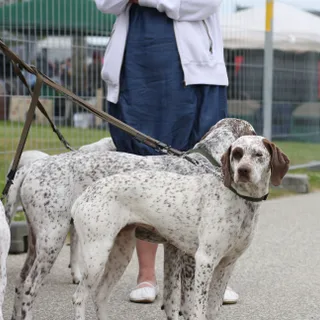
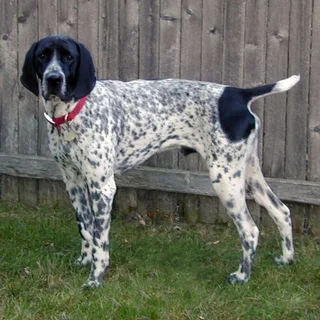
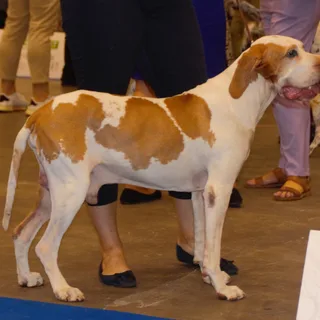
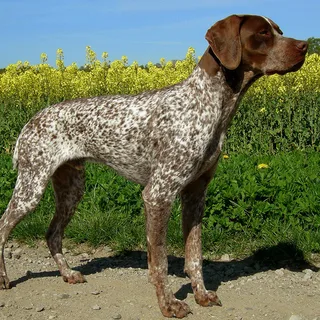
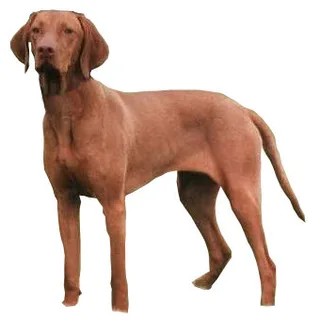
The Braque Saint-Germain is a medium-sized dog, braccoid, built for endurance with lean, well-defined musculature. Its body is medioline, the back horizontal, the chest long and wide, and the muscular neck rather long. Its coat is dull white marked with fawn spots, with ears also fawn. The head has a slightly domed skull, very gentle golden eyes and moderately long ears with rounded tips. The coat is short, without being too fine.
Temperament
Temperament and personality
The Braque Saint-Germain is a sensitive, affectionate and sociable dog, very attached to its owner and its family. When hunting, it stands out for its passion, determination and endurance, with real aptitudes for pointing and retrieving. At home, it is generally well-balanced, gentle in its interactions and pleasant to live with when it gets enough exercise.
Living together
Living with children and animals
This dog does not tolerate prolonged inactivity well and needs long regular outings, ideally in natural areas where it can trot, sniff and expend energy. More at ease in the countryside than in the city, it can nevertheless adapt to an urban setting if its need for exercise is truly taken into account. Its sensitive temperament makes it unreceptive to harshness, and it seeks a relationship of trust with those close to it.
Training
Training and socialization
The education of the Braque Saint-Germain must be carried out with gentleness, patience and consistency. This dog does not cope well with brutal methods, but responds well to a clear framework, to early learning of recall and to positive motivation. Its level of obedience is correct, especially when the sessions remain coherent, progressive and adapted to its sensitive temperament as a hunting dog.
Budget
Braque Saint-Germain price & budget
The purchase price of the Braque Saint-Germain generally remains moderate for a French pointing dog, but it varies depending on the lineage, the seriousness of the breeding and the puppy’s intended purpose. You should also anticipate the maintenance budget for an active dog, which includes food, veterinary prevention and basic equipment.
View cost breakdownHealth
Health at a glance
The Braque Saint-Germain enjoys generally robust health when it benefits from an active lifestyle, a suitable diet and regular veterinary follow-up. It is an overall hardy dog, but its owner must remain attentive to the skin, the ears and minor issues related to the life of a hunting dog.
Prevention & watch pointsDiet
Feed it well
The Braque Saint-Germain needs a good-quality diet, formulated for an adult dog of medium size with often sustained activity. The ration must be adapted to its age, its level of exercise and its body condition, taking into account variations between hunting season and calmer periods.
Our feeding adviceDid you know?
Anecdotes and popularity
The Braque Saint-Germain owes its name to Saint-Germain-en-Laye and is part of the old French breeds of pointing dogs. Its history is linked to the royal kennels of the 19th century, which gives it a particular place in the French canine heritage. Despite its qualities, it remains today quite rare, with a limited annual number of births.