Origins
Where does it come from?
An old French breed originating from the historic region of Bourbonnais, corresponding in particular to the current department of Allier, the Braque du Bourbonnais is mentioned as early as the end of the 16th century in the work Natural History by the naturalist Ulisse Aldrovandi, published in 1598. After the 1930s, an overly restrictive selection aimed at dogs naturally without a tail led the breed to the brink of extinction. From the 1970s, passionate breeders relaunched a conservation program based on the quality of the dogs and their hunting abilities. The Fédération Cynologique Internationale definitively recognized the breed on 29 June 1955.
Appearance
What does it look like?
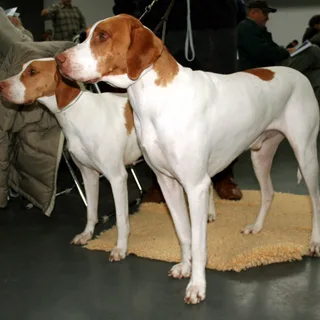
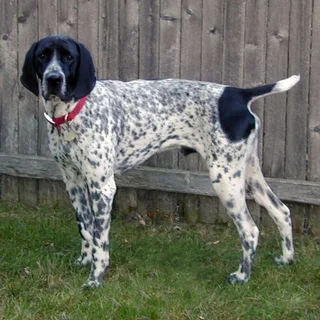
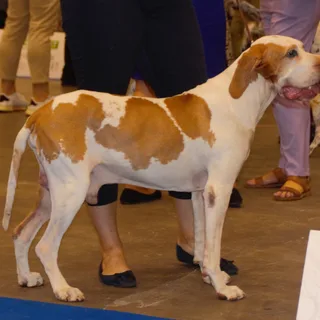
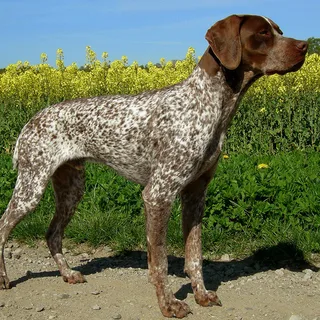
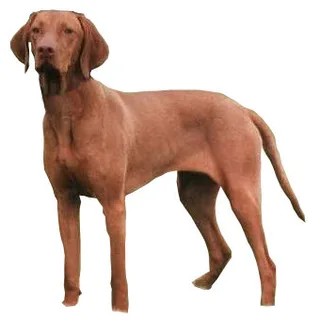
The Braque du Bourbonnais is a medium-sized pointing dog, stocky and harmonious, combining strength and elegance. Its back is straight, its withers well defined and its musculature firm. Its characteristic head, described as pear-shaped, has a moderate stop, a broad nose and a powerful muzzle that tapers toward the tip. Its large rounded eyes, hazel to dark amber, express gentleness and intelligence. Its ears, broad at the base, are set at eye level and hang flat. The coat, very short, fine and dense, is slightly thicker on the back. The predominantly white coat is speckled with brown or ticked with fawn. The tail, set rather low, may be naturally absent in some dogs.
Temperament
Temperament and personality
Passionate, intelligent and determined, the Braque du Bourbonnais has the qualities of a versatile pointing dog capable of working with precision on varied terrain and game. At home, it reveals a gentle, tender and affectionate temperament. Close to its owners, it enjoys family life and is generally good with children. Early socialization promotes a peaceful cohabitation with its fellow dogs and other animals.
Living together
Living with children and animals
Active and enduring, this hunting dog needs long daily outings and regular activities that engage its sense of smell, its recall and its physical abilities. It thrives particularly in the countryside or with an athletic household. An urban life remains possible if its exercise needs are truly met, but simple hygienic walks do not suit it. After sufficient activity, it knows how to be calm and affectionate within the household.
Training
Training and socialization
Its training must combine firmness, gentleness and consistency. Intelligent and receptive, the Braque du Bourbonnais makes good progress with short, regular and motivating sessions. Recall, long-line walking and control of the chasing instinct must be worked on early. Positive methods should be favored, while maintaining clear and consistent rules.
Budget
Bourbonnais Pointer price & budget
The price of a Braque du Bourbonnais varies depending on the quality of the breeding, the lineage, the health guarantees, registration with the LOF and the dog's intended purpose, notably companionship, hunting or showing.
View cost breakdownHealth
Health at a glance
Rustic and generally robust, the Braque du Bourbonnais enjoys fairly solid health. The breed nevertheless shows predispositions to certain dermatological conditions and its drooping ears require attentive monitoring, especially after outings in vegetation or humid areas.
Prevention & watch pointsDiet
Feed it well
The Braque du Bourbonnais needs a complete, digestible diet adapted to its activity level. The needs of a companion dog differ greatly from those of a dog hunting for several hours, which requires adjusting the ration according to actual expenditure.
Our feeding adviceDid you know?
Anecdotes and popularity
The Braque du Bourbonnais is recognizable by its light coat finely speckled, traditionally described in two shades, wine lees for brown and peach blossom for fawn. Some puppies are born with a very short tail or no tail, a historical characteristic of the breed which must however never take precedence over health, temperament and functional abilities.