Origins
Where does it come from?
Appearing during the 19th century, the Braque de l'Ariège comes from the cross between the old Braque Français and different lines of pointing dogs from the South. Having become rare outside its region of origin, it is today preserved by enthusiasts and breeders attached to its qualities as a pointing dog. The Fédération Cynologique Internationale definitively recognized the breed on 28 June 1955 under number 177.
Appearance
What does it look like?
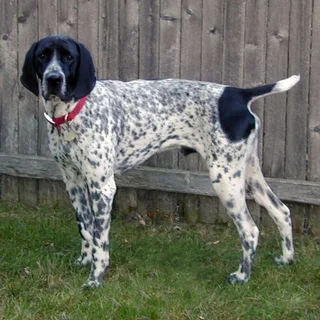
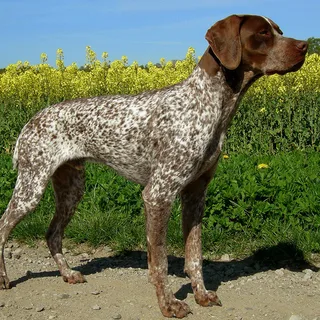
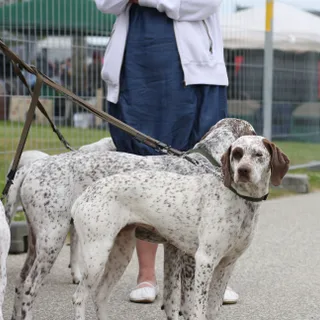
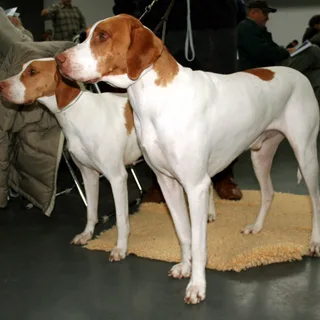
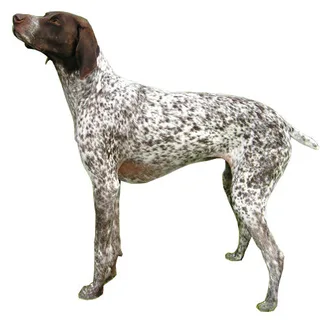
The Braque de l'Ariège is a dog of the braccoid type, solidly and harmoniously built, powerful without heaviness and endowed with prominent musculature. Its head is long and narrow at the level of the zygomatic arches, with a slightly domed skull, a not very marked stop and a long, straight muzzle. The nose can be pink, reddish or brown. Its oval eyes, well open, dark amber or brown, express gentleness, frankness and intelligence. Its long and not very thick ears are set at the level of or below the line of the eye. The neck is strong, the withers well defined and the back a little long, muscular and straight. The tail, thick at the base then tapered, continues the line of the croup without exceeding the topline. The coat is short, shiny and close, finer and very short on the head and ears. The coat color is pale orange fawn or brown, ticked or speckled with white.
Temperament
Temperament and personality
Versatile, determined and very hardy, the Braque de l'Ariège has the qualities expected of a hunting dog and an excellent pointing dog. Attached to its owner, it can also be a good companion on a daily basis. Its hunting instinct is very pronounced, while its temperament combines a certain independence with real closeness to its handler.
Living together
Living with children and animals
This active dog needs freedom, space and long, frequent outings, ideally in the countryside or in wooded areas. Rural life suits him particularly well. In the city, a large, well-fenced garden and regular activities are essential. He is not suited to apartment living or to a daily routine limited to short walks.
Training
Training and socialization
His training must begin early and combine firmness, consistency and gentleness, without brutality. Recall is a priority in order to better control his hunting instinct during outings. Intelligent and of average obedience, he makes progress with a clear framework and regular training.
Budget
Braque de l'Ariège price & budget
The purchase price varies depending on the breeder, the lineage, the age and the guarantees provided with the dog.
View cost breakdownHealth
Health at a glance
The Braque de l'Ariège is a hardy dog that enjoys particularly robust health. The reference sheet does not indicate any predisposition specific to the breed. It is not hypoallergenic.
Prevention & watch pointsDiet
Feed it well
The Braque de l'Ariège is an active pointing dog that needs a complete diet, sufficiently energetic on hunting days or long outings, and more moderate at rest. Good digestibility and weight control protect the joints.
Our feeding adviceDid you know?
Anecdotes and popularity
The breed is also known under the names Braque du Midi and Braque de Toulouse. Definitively recognized by the FCI in 1955, it remains little represented outside Ariège. A litter generally includes 2 to 5 puppies.