Origins
Where does it come from?
Native to the Catalan Pyrenees, the Berger Catalan is said to descend from the Bergamasco Shepherd and local dogs adapted to the climate and terrain of the region. It established itself among the shepherds of Catalonia to drive and guard flocks. Its numbers declined during the 20th century before a renewed interest in the early 1970s. A first standard was established in Spain in 1929, then the breed was definitively recognized by the Fédération Cynologique Internationale on 30 November 1954 under number 87.
Appearance
What does it look like?
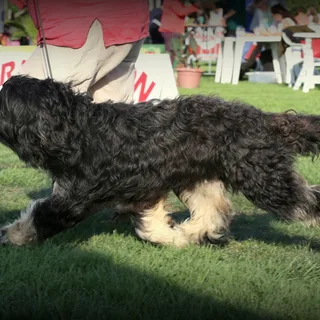
The Berger Catalan is a medium-sized dog, slightly elongated, strong, muscular and agile. Its well-proportioned head has round dark amber eyes and triangular ears, fine, drooping and fringed. Its harsh, long, flat or slightly wavy coat forms a beard, moustache, a tuft on the skull and eyebrows without masking the gaze. The coat appears solid-coloured from a distance, but results from a mixture of fawn, reddish-brown, grey, white and black shades; a black and tan coat is also possible. The tail, set low and abundantly furnished, may be naturally very short or extend beyond the hock.
Temperament
Temperament and personality
Intelligent, thoughtful and very loyal, the Catalan Sheepdog has a strong instinct for herding and guarding flocks. Gentle with children and devoted to his family, he needs to feel loved and useful. Vigilant and protective, he is reserved, even wary, toward strangers, while knowing how to take initiative when the situation requires it.
Living together
Living with children and animals
Enduring and willing, he enjoys long walks, running and outdoor activities with his owner. He adapts to family life and generally accepts other dogs, but prefers a house with a garden to an apartment. Even with an outdoor space, frequent outings remain essential. He copes poorly with prolonged solitude and thrives with an available person.
Training
Training and socialization
Attentive, intelligent and willing to cooperate, the Catalan Sheepdog is trained with consistency, patience and measured firmness. Positive methods, stable rules and activities that engage its intelligence help to channel its initiative. Early and varied socialization is important to reduce its natural wariness of strangers and encourage calm interactions with other animals.
Budget
Catalan Sheepdog price & budget
The price of a Berger Catalan varies depending on the quality of the breeding, the pedigree, the parents' health tests, the bloodline and the puppy's intended purpose. The breed's relative rarity in France can also influence availability and travel costs.
View cost breakdownHealth
Health at a glance
Rustic and resilient, the Catalan Sheepdog generally enjoys good health and does not show any widely recognized particular predisposition. As with any active dog of this size, gradual growth, a balanced diet and activity adapted to age help preserve joints and cartilage.
Prevention & watch pointsDiet
Feed it well
The Catalan Sheepdog is satisfied with a simple, balanced diet adapted to its age, weight and activity. A ration that is too fatty or too rich does not suit it and must be avoided.
Our feeding adviceDid you know?
Anecdotes and popularity
The shedding of the Berger Catalan takes place in a singular way in two phases: the coat of the front part of the body renews first, then that of the rear part, which can temporarily give the impression of a coat divided in two. The breed is also known under the names Gos d'Atura Català, Berger de Catalogne, Perro de Pastor Catalan and Catalan Sheepdog.