Origins
Where does it come from?
Contrary to what its name suggests, the Australian Shepherd is not originally from Australia. The breed was developed in the United States by farmers at the beginning of the 20th century to gather and drive livestock. Its ancestors are believed to have been herding dogs of Basque origin, which passed through Australia before reaching North America. Its popularity increased sharply after World War II, first on ranches for its working qualities, then as a family and sport dog.
Appearance
What does it look like?
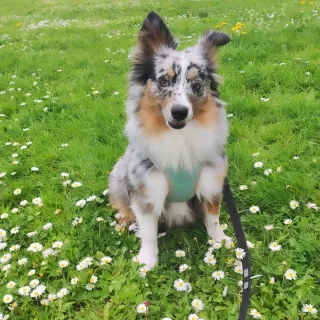
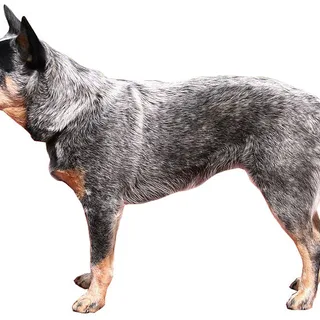
The Australian Shepherd is a medium-sized dog, slightly longer than tall, with well-sprung ribs, a deep chest and a slightly sloping croup. Its coat is of medium length, straight or slightly wavy, double and shorter on the head and ears, with a slight ruff in males. Its ears are triangular and drop, its almond-shaped eyes can be amber, brown, blue or mottled, and its straight tail must not exceed 10 cm. The coat can be blue merle, red merle, red or black, with or without white and tan.
Temperament
Temperament and personality
An action dog, playful, curious and loyal, the Australian Shepherd combines great energy with an overall balanced temperament. He is very attached to his family, likes to take part in everything that happens in the home and shows remarkable intelligence. Versatile at work as well as in sporting activities, he often remains a little reserved with strangers without being naturally quarrelsome.
Living together
Living with children and animals
The Australian Shepherd needs space, companionship and daily activity. It is not very well suited to apartment living and thrives more in a home able to offer it frequent outings, games, learning and canine activities. A daily walk of at least 30 minutes can be a base, but this athletic dog above all needs real physical and mental exercise to avoid boredom.
Training
Training and socialization
Education can start very early, from the age of 2 months, with a firm approach but without violence. The Australian Shepherd responds well to rewards and encouragement, while brutality does not suit him well. His liveliness and strong-willed temperament make early socialization essential, and sharing activities such as agility, canicross or obedience often contributes greatly to his balance.
Budget
Australian Shepherd price & budget
The price of an Australian Shepherd varies mainly depending on the quality of the selection, the health tests of the breeding dogs, the reputation of the kennel and the potential of the line. A consistent price normally comes with good follow-up, clear identification and precise information on the screenings carried out.
View cost breakdownHealth
Health at a glance
The Australian Shepherd is generally robust, but it has well-identified predispositions to several hereditary conditions. Vigilance mainly concerns hereditary canine eye diseases, hip and elbow dysplasia, epilepsy and certain skin conditions. Particular attention must also be paid to sensitivity to certain treatments, notably those containing ivermectin.
Prevention & watch pointsDiet
Feed it well
The Australian Shepherd needs a complete and digestible diet, capable of supporting an often sustained activity without promoting weight gain. Energy density, the quality of animal proteins and the regularity of intake are essential to maintain its muscle mass and its recovery.
Our feeding adviceDid you know?
Anecdotes and popularity
The Australian Shepherd owes part of its modern popularity to its versatility and its ease in dog sports, but also to several cultural appearances. One can notably mention Huck in the film Marmaduke, where several Australian Shepherds were used on screen. Its spectacular appearance must not, however, make one forget that it remains above all a true working and active dog.