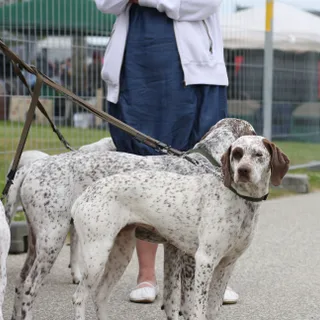
Longevity
Life expectancy
Its usual lifespan is between 11 and 13 years. Maintaining a stable weight, appropriate physical activity and early detection of ear disorders promote a long and active life.
Build
A robust breed?
Its solid build and protective coat make it a hardy dog, suited to outdoor work. This robustness does not eliminate the need for regular checks of the ears, eyes, skin and joints, particularly in a very active dog.
Watch points
What to watch for
Particular attention must be paid to the ears after outings, swimming or work in a humid environment. In this sporty dog of medium to large size, locomotion, recovery after exertion and body condition must also be monitored throughout life.
Otitis : Drooping ears and frequent work in wet environments promote inflammation; appropriate inspection, drying and cleaning are necessary.
Locomotor disorders : As with any sporting dog of this size, lameness, stiffness or decreased performance should lead to a veterinary examination.
Heatstroke : Its limited tolerance to high heat requires reducing exertion, providing water and monitoring any abnormal panting.
Climate
Cold and heat tolerance
Thanks to its harsh coat and dense undercoat, the Czech Wirehaired Pointer copes well with cold and humidity. It tolerates high heat less well: activities must then be scheduled during the cooler hours, with shade, breaks and water available at all times.
Weight
Tendency to gain weight
Its high activity level generally makes it easier to maintain a proper weight, but the ration must match actual expenditure and decrease during rest periods. The ribs must remain palpable without being prominent and the waist visible. Weight gain requires adjusting portions and treats with the veterinarian.
Daily life
Good habits to keep it healthy
- Inspect and dry the ears after each outing in a humid environment.
- Brush at least once a week and more during shedding.
- Examine the paw pads, eyes and skin when returning from outings.
- Keep vaccines, antiparasitics and veterinary check-ups up to date.
- Limit exertion during hot hours and always offer water.
Vaccination
Bohemian Wire-haired Pointing Griffon vaccines: vaccination schedule
Which vaccines for a Bohemian Wire-haired Pointing Griffon? Like all cats, the Bohemian Wire-haired Pointing Griffon receives essential vaccines from 8 weeks old: Typhus (panleukopenia) and Coryza. The kitten primary vaccination for Bohemian Wire-haired Pointing Griffon is given in several injections 4 weeks apart, followed by a first booster at 1 year, even if it lives in an apartment. Depending on its lifestyle (outdoor access, multi-cat household, shows, travel), your veterinarian may complete the protocol with vaccines against Feline leukemia (FeLV), Rabies and Chlamydiosis.
| Vaccine | Primary series | First booster | Then | Who for? |
|---|---|---|---|---|
Typhus (panleukopenia)Core Feline panleukopenia (cat parvovirus) | 8 weeks · 12 weeks · 3 months | 1 year | every year | All pets |
CoryzaCore Feline herpesvirus and calicivirus | 8 weeks · 12 weeks · 3 months | 1 year | every year | All pets |
Feline leukemia (FeLV)Lifestyle-based Feline leukemia virus | 8 weeks · 12 weeks | 1 year | every year | Outdoor cats, cats living in a group or in a cattery |
RabiesLifestyle-based Rabies | 12 weeks | 1 year | every year | Mandatory for travel abroad, cat shows and most boarding kennels |
ChlamydiosisLifestyle-based Chlamydia felis (contagious conjunctivitis) | 8 weeks · 12 weeks | 1 year | every year | Cats living in groups, catteries, show cats |
Adult Bohemian Wire-haired Pointing Griffon vaccine boosters are annual for cat flu and leukemia if it goes outdoors; for panleukopenia, a booster every three years is often sufficient after the first booster. Your veterinarian will adjust the schedule to your cat’s lifestyle.
Which boosters for your Bohemian Wire-haired Pointing Griffon?
Enter your companion’s age: we list the vaccines to do now and the next boosters.
Adopting well
Adopting a healthy Bohemian Wire-haired Pointing Griffon
Before an acquisition, it is prudent to ask for the results of the examinations recommended by the breed club and the health history of the breeding dogs. An annual veterinary follow-up must include examination of the ears, skin, eyes, teeth, heart and locomotor system, with checks adapted to age and activity.
This information is provided for guidance only and does not replace a veterinarian’s advice. If you have any concerns about your pet’s health, consult a professional.