Origins
Where does it come from?
The Anglo-French Small Game Hound comes from crossbreeding between French and English scenthounds, notably the Petit Bleu de Gascogne, the Porcelaine, the Poitevin and the Harrier. First called Petit Anglo-French, it received its current name when its first standard was published in 1978. The Fédération Cynologique Internationale recognized it definitively on 26 January 1983 under number 325, in group 6. Selected mainly to pursue the hare, it is also used for hunting with hounds or with a gun on other game, including roe deer and wild boar.
Appearance
What does it look like?
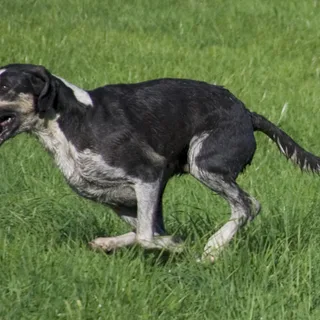
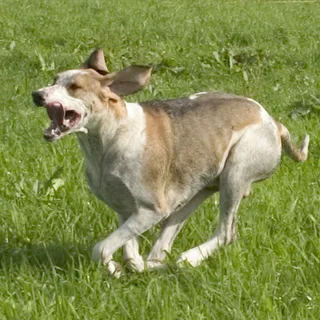
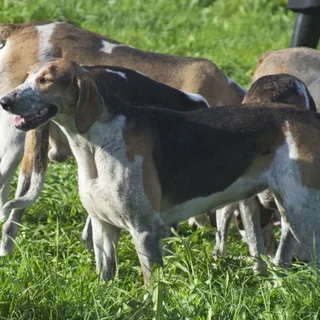
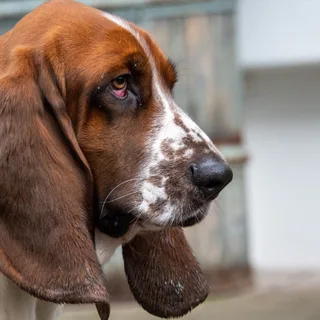
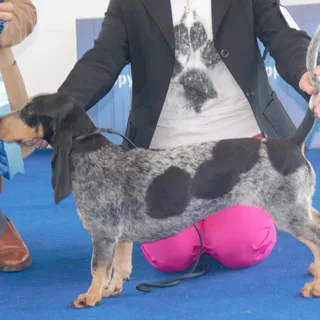
Of medium size, the Anglo-French Small Game Hound shows a robust, balanced build without heaviness. Its rather long head has a slightly convex skull, a little marked stop, a moderately elongated muzzle and a well pigmented nose. Its large brown eyes express gentleness and liveliness. The ears are fine, supple, slightly turned and set below the line of the eye. The back is straight and well supported, the loin short and muscular, the croup slightly sloping and the chest well let down. The tail, of medium length and rather fine, is furnished with abundant hair. The coat is short, smooth and close. The coat colour can be bicolour white and orange with a tobacco nose, or tricolour white and black with tan markings and a black nose.
Temperament
Temperament and personality
Courageous, keen at work and intelligent, the Anglo-French Small Game Hound is above all an enduring and fast hunting dog. Used to working in a pack, it readily cooperates with its fellow dogs. With its owner, it is kind, docile and affectionate, without being excessively dependent. The standard calls for a balanced temperament, neither aggressive nor fearful. Its very strong hunting instinct and its low interest in guarding must nevertheless be taken into account in everyday life.
Living together
Living with children and animals
Very active, this dog needs long outings every day, olfactory exploration and sustained physical activities. A rural life or access to a well-enclosed plot suits it better than an apartment. It can adapt to an urban environment only if its needs for exercise and stimulation are fully met. Sociable with other dogs thanks to its pack-dog heritage, it must be accustomed early to small animals, which its chasing instinct may prompt it to pursue.
Training
Training and socialization
Intelligent and rather obedient, the Anglo-French Small Game Hound learns well with consistent, positive and regular training. Socialization must begin from the youngest age and include varied encounters with humans, dogs and other animals. Recall deserves particularly rigorous work due to its powerful hunting instinct. Short, dynamic sessions based on cooperation give better results than harsh methods, which risk damaging trust.
Budget
Anglo-French Small Game Hound price & budget
The acquisition cost depends mainly on the breeder, the pedigree, the quality of the hunting line, the age and the availability of the puppies. To the purchase price must be added veterinary expenses, food, equipment and securing the living area.
View cost breakdownHealth
Health at a glance
The Anglo-French Small Game Hound is generally hardy and enjoys robust health. No major hereditary predisposition is particularly reported for the breed. Like any active scenthound, it must nevertheless be subject to regular monitoring, especially after outings in vegetation or on rough terrain.
Prevention & watch pointsDiet
Feed it well
Its diet must meet the needs of a very active scenthound without causing excess calorie intake during rest periods. The ration varies greatly depending on age, weight, season, work intensity and body condition.
Our feeding adviceDid you know?
Anecdotes and popularity
Its qualifier of Petite Vènerie does not describe its size, which remains medium, but the type of game traditionally hunted in petite vènerie, mainly the hare. The breed bore the name Petit Anglo-Français before the adoption of its current name in 1978. Its speed, its endurance and its aptitude for collective work explain its reputation among hunting packs.