Origins
Where does it come from?
The American Staffordshire Terrier descends from Bull-and-Terrier type dogs developed from Bulldogs and Terriers formerly used in fights. Modern selection was structured in North America at the beginning of the 20th century, with the objective of establishing a more homogeneous, powerful and balanced dog. The American Kennel Club recognized it in 1936 under the name Staffordshire Terrier, then the name American Staffordshire Terrier was adopted in 1972 in order to distinguish it from the Staffordshire Bull Terrier. The Fédération Cynologique Internationale recognizes it under number 286 in group 3 of Terriers. The breed has been present in France since the end of the 1980s.
Appearance
What does it look like?
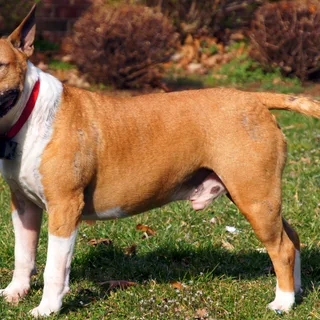
Compact, athletic and very muscular dog, the American Staffordshire Terrier gives an impression of power without heaviness. Its medium-length head has a broad skull, very muscular cheeks, a muzzle rounded on its upper part and dark, round, well-spaced eyes. The ears are short, set high and generally semi-erect. The back is short, the chest deep and the bone structure strong. The tail, short and set low, is carried without curling over the back. Its coat is short, harsh, close and glossy. Many colours are accepted, but coats with more than 80 % white as well as black and tan are not encouraged by the standard.
Temperament
Temperament and personality
The American Staffordshire Terrier is loyal, affectionate, patient and close to its family. Intelligent, lively and courageous, it also has a strong will and can be stubborn. Properly socialized and trained without violence, it proves gentle, docile and friendly. Its protective instinct makes it a deterrent guard dog, but its aggressiveness must never be encouraged. Its balance depends on serious selection, early positive experiences and a consistent framework.
Living together
Living with children and animals
At home, he can be calm, clean and reserved when he gets sufficient outings. He enjoys games, active walks and activities shared with his owner. Apartment living is possible, provided that several daily outings and real physical and mental exercise are planned. A fenced garden is an advantage but does not replace walks. Meetings with children and other animals must remain supervised, especially because of his power. In France, dogs of this breed registered in a recognized genealogical book fall under the second category and are subject to the applicable legal obligations, notably a holding permit, behavioral assessment, insurance, leash and muzzle in the places provided for by the regulations.
Training
Training and socialization
His training must begin from the youngest age and combine firmness, consistency, gentleness and rewards. Early socialization with people, dogs, varied environments and noises is essential. Brutal methods are counter-productive and can reinforce undesirable reactions. Recall, leash walking, self-control, giving up and acceptance of the muzzle must be worked on progressively. His great intelligence makes learning easier, but his strong-willed temperament requires an available, consistent owner capable of channeling his energy.
Budget
American Staffordshire Terrier price & budget
The price varies depending on registration with the LOF, the reputation of the breeding kennel, the quality of health selection, the pedigree, the age and the dog's intended purpose. The acquisition cost must be supplemented by the regulatory, food, veterinary and training expenses specific to this powerful breed.
View cost breakdownHealth
Health at a glance
The American Staffordshire Terrier is generally robust and its athletic build allows it to remain active for a long time. Careful selection and regular veterinary monitoring remain necessary to limit the joint, neurological, endocrine, ocular and skin conditions reported in the breed.
Prevention & watch pointsDiet
Feed it well
This muscular and active dog needs a complete, digestible diet that is sufficiently rich in good-quality proteins. The energy intake must support its activity without promoting weight gain, with particular attention during growth.
Our feeding adviceDid you know?
Anecdotes and popularity
Often nicknamed Amstaff, the American Staffordshire Terrier must not be confused with the American Pit Bull Terrier, even if their history shares common origins. Its current name dates from 1972. Despite an sometimes reductive image, a well-selected subject, correctly socialized and handled with responsibility can be a stable family companion and very attached to its loved ones. In France, its regulatory status involves specific procedures that the future owner must know before acquisition.