Origins
Where does it come from?
Originally from Yorkshire, in the United Kingdom, the Airedale Terrier seems to have been used as early as the middle of the 19th century. It is mainly said to come from crosses between the Otterhound and the Old English Black and Tan Terrier, with a Bull Terrier contribution. First used for hunting otters and rats, it distinguished itself by its scenting ability, its determination and its versatility, to the point of receiving the nickname "king of terriers". The British and Russian armed forces also used it as a liaison and service dog. The FCI definitively recognized the breed on 28 May 1963.
Appearance
What does it look like?
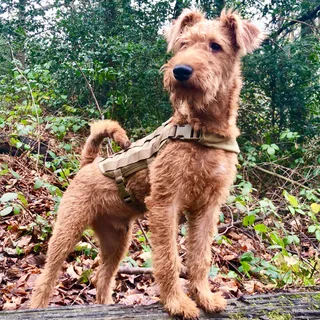
The Airedale Terrier is a medium-sized dog, muscular, lively and well proportioned, whose relatively long limbs distinguish it from many other terriers. Its elongated head has a long and flat skull, a slightly marked stop, small dark eyes and V-shaped ears carried to the side. Its back is short, straight and solid, its loin muscular and its chest well let down. Its tail, set high and strong, is carried gaily. Its harsh, dense, wire-like coat lies over a short and soft undercoat. The coat is black or grizzled, while the rest of the body is tan, with darker shades on the ears, the neck and on the sides of the head.
Temperament
Temperament and personality
Alert, courageous and full of confidence, the Airedale Terrier combines great energy with a strong-willed temperament. He likes to work and share activities with his owner, but his independence and terrier instinct can make his obedience inconsistent. Alert and protective, he makes a good guard dog. He is generally sociable with his family and friendly with children when he has been properly trained and socialized.
Living together
Living with children and animals
On a daily basis, the Airedale Terrier needs an available presence, long outings and varied activities. Playful and passionate about exploration, it enjoys wide open spaces and activities that engage its sense of smell. It can live in an apartment if its physical and mental needs are truly met, but an active environment suits it better. Its hunting instinct and its tendency to challenge other dogs, especially those of the same sex, require early socialization and supervised meetings.
Training
Training and socialization
His training must begin early and be based on clear, consistent and firm rules, without a power struggle. Short, stimulating and rewarded sessions hold his attention better than repetitive work. Recall, leash walking and control of chasing are priorities. Thorough socialization with people, dogs and other animals helps channel his exuberance and prevent belligerent behavior.
Budget
Airedale Terrier price & budget
The price of an Airedale Terrier varies depending on the quality of the breeding, the pedigree, the parents' health tests, the puppy's intended purpose and the reputation of the line. The acquisition budget must be supplemented by equipment, food, grooming and veterinary follow-up expenses.
View cost breakdownHealth
Health at a glance
The Airedale Terrier is generally robust and withstands climatic conditions well. Like any breed, it nevertheless has certain predispositions that justify careful selection of breeding dogs, regular veterinary monitoring and particular vigilance regarding the joints and the risk of gastric dilatation-volvulus.
Prevention & watch pointsDiet
Feed it well
The Airedale Terrier needs a complete, balanced diet adapted to its age, weight, activity level and physiological condition. Its ration must support its musculature and endurance without promoting overly rapid growth or weight gain.
Our feeding adviceDid you know?
Anecdotes and popularity
The Airedale Terrier is the largest of the British terriers, which has earned it the nickname "king of terriers". Its versatility has allowed it to serve as a hunting dog, guard dog, messenger dog and military service dog. It has also borne the names Bingley Terrier, Waterside Terrier, Working Terrier and Warfedale Terrier throughout its history.