Origins
Where does it come from?
The Bedlington Terrier is an old British breed originating from the mining regions of northern England. First known as the Rothbury Terrier, it is said to count among its ancestors in particular the Dandie Dinmont Terrier, otter dogs and the Whippet. It was used to hunt rabbit and fox, but also to rid the mining galleries of rats. Its reputation went beyond its region of origin at the end of the 19th century, without however making it a very widespread breed in France. The Fédération Cynologique Internationale definitively recognized it on 20 June 1963.
Appearance
What does it look like?
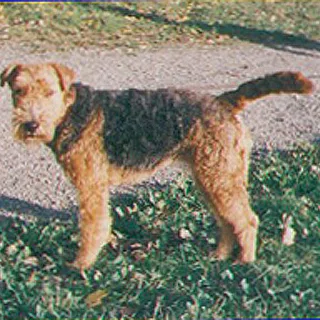
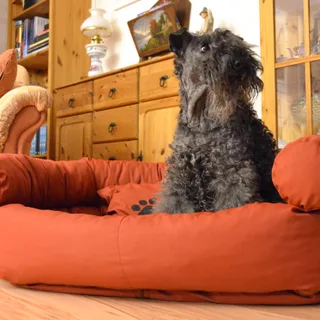
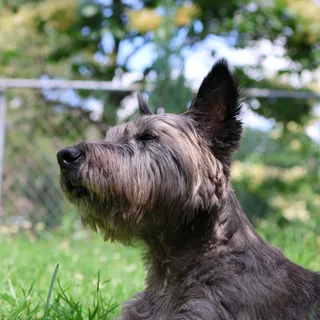
Small, graceful, muscular and supple dog, the Bedlington Terrier has a very characteristic silhouette with a naturally arched back, a high chest and a tucked-up underline. Its long, narrow, wedge-shaped head is topped with a silky, almost white topknot, without a pronounced stop. Its small triangular eyes vary according to the coat, while its long, fine, drop ears carry a silky fringe. Its thick, felted and standing coat tends to curl, especially on the head and face. The coat can be blue, brown or sand, with or without tan markings. Its low-set tail forms an elegant curve.
Temperament
Temperament and personality
Beneath its gentle appearance lies a true terrier, brave, lively and determined. The Bedlington Terrier is very affectionate and devoted to its owner, cheerful and playful, while knowing how to remain calm between two periods of activity. Intelligent and curious, it retains a strong hunting instinct and can be stubborn. It readily protects its home without being naturally aggressive and generally prefers to avoid conflict, even if it knows how to defend itself when provoked.
Living together
Living with children and animals
The Bedlington Terrier adapts to different living environments if its physical and mental needs are met. Apartment living is possible with one to two long daily outings, complemented by games and scent activities. It generally lives well with respectful children, but its liveliness requires supervision with the youngest. Early socialization makes life with dogs and cats easier. On the other hand, its predatory instinct makes cohabitation with rodents delicate. A lack of activity can promote boredom and destructive behaviors.
Training
Training and socialization
His intelligence and his taste for learning allow good results, but his assertive temperament requires early, consistent and patient training. The owner must set clear rules without harshness, because a hard method can cause opposition and loss of trust. Positive reinforcement, short and varied sessions as well as sustained socialization work are particularly suitable for this breed. Despite his qualities, the Bedlington Terrier is not the simplest choice for a completely novice owner, who would benefit from being accompanied by a dog trainer.
Budget
Bedlington Terrier price & budget
The price depends on the rarity of the breed in France, the reputation of the kennel, the quality of the pedigree, the screenings carried out on the parents and the puppy’s intended purpose. The maintenance budget must also include regular professional grooming.
View cost breakdownHealth
Health at a glance
The Bedlington Terrier is hardy and can live a long time, but the breed has several hereditary predispositions that justify a rigorous choice of breeding and regular veterinary monitoring. Copper toxicosis is the most emblematic risk. The eyes, kidneys and joints also deserve particular attention.
Prevention & watch pointsDiet
Feed it well
The diet must cover the needs of a small active dog while maintaining a lean silhouette. The ration is chosen according to age, weight, activity level, health status and neutering, then adjusted based on changes in body condition.
Our feeding adviceDid you know?
Anecdotes and popularity
Before taking its current name, the breed was called Rothbury Terrier in reference to a locality in Northumberland. Its little lamb-like appearance contrasts with its past as a hunter and ratter in the mine galleries. Its atypical silhouette owes a lot to a very codified clipping, which highlights the topknot, the fringed ears and the arched back.