Origins
Where does it come from?
The Sokoké originates from the Sokoke-Arabuke forest, in Kenya, where it lived in a semi-wild state under the name Khadzonzo. The breed began to be domesticated at the end of the 1970s, when Jeni Slater, a British woman living in Kenya, took in kittens found in a tree and raised them. The development of the breed then continued in Denmark, where several individuals were presented and bred in order to ensure its continuity. First called African Shorthair, this cat finally took the name Sokoké at the beginning of the 1990s.
Appearance
What does it look like?
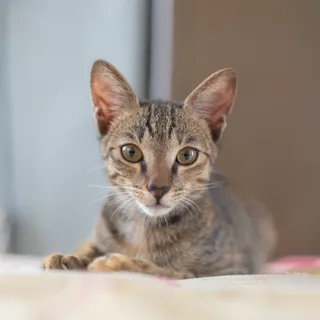
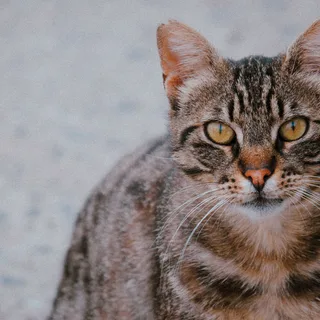
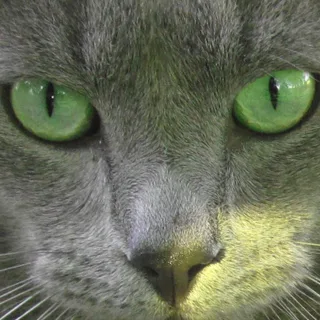
The Sokoké is a semi-foreign type cat, slender, muscular and athletic, without heaviness. Its body is balanced, with a fairly developed chest and hind legs that are slightly more angulated, which accentuates its lively appearance. Its head forms a softened triangle, with large ears wide at the base and almond-shaped eyes ranging from green to amber. Its coat is very short, close-lying to the body, devoid of undercoat, and the standard looks for an elongated marble tabby pattern with black ticked hairs.
Temperament
Temperament and personality
The Sokoké is an expressive, sociable and playful cat, while still retaining a real degree of independence. It becomes attached to its family, enjoys the company of children and generally lives well with other cats as well as with other animals that are properly introduced. Very communicative, it readily uses its voice to interact with those around it. Its temperament remains shaped by its natural origins, which makes it a curious, agile cat that is always on the move.
Living together
Living with children and animals
The Sokoké likes to climb, jump, explore and observe its environment from above. It tolerates poorly a totally confined life and is much more fulfilled when it has space, structures to climb and opportunities to expend energy. Even when it lives indoors, it needs significant daily enrichment to avoid boredom. It is also a cat often alert, playful and sometimes talkative, which appreciates regular interactions without being constantly glued to its human.
Training
Training and socialization
The education of the Sokoké must be consistent, gentle and stimulating. This cat learns routines well, the limits of the home and certain interaction games when they are introduced with patience and positive reinforcement. Its intelligence and curiosity are real assets, but its need for autonomy requires avoiding any abrupt or punitive approach. A rich environment, daily play sessions and stable reference points are essential to channel its energy.
Budget
Sokoké price & budget
The Sokoké remains a rare breed, which directly influences its purchase price. The price mainly depends on the rarity of the available lines, the seriousness of the breeding, the quality of health monitoring, and the kitten’s intended purpose, companionship or breeding.
View cost breakdownHealth
Health at a glance
The Sokoké is generally considered a healthy and hardy breed. No specific hereditary disease is clearly documented to date, which makes it a rather robust cat when it comes from a reputable breeding program and is properly monitored throughout its life.
Prevention & watch pointsDiet
Feed it well
The Sokoké needs a good-quality diet, rich in animal proteins and adapted to its age, activity level and physiological status. Its active profile calls for a well-calibrated ration, without unnecessary excess energy.
Our feeding adviceDid you know?
Anecdotes and popularity
The Sokoké is one of the rare feline breeds directly linked to a natural population from East Africa. Its former name, Khadzonzo, recalls its local roots. It is often described as an excellent climber, and several portraits of the breed also highlight its unusual ease with water for a domestic cat.