Origins
Where does it come from?
Also called Birman, the Sacré de Birmanie should not be confused with the Burmese. Its exact origins remain debated and have given rise to several accounts, including a legend linked to a Khmer temple. On a more historical level, the breed is generally considered to have been developed in France at the beginning of the 20th century from cats brought from Burma, then exhibited from the 1920s. It declined sharply after the Second World War before being gradually reconstituted.
Appearance
What does it look like?
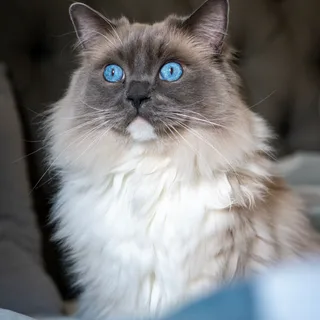
The Sacred Birman is a medium-sized cat with a rather long body, well muscled and harmonious. Its semi-long coat is silky, shorter on the face and more abundant on the back, the flanks and the ruff. The triangular head with rounded contours, the large ears with soft tips and above all the intense blue eyes reinforce its gentle expression. The paws have characteristic white gloves, essential in the identity of the breed.
Temperament
Temperament and personality
The Sacred Birman is renowned for its very gentle, calm and affectionate temperament. It readily seeks the closeness of its humans, is delicate in its interactions and generally suits family life very well. Sociable without being constantly intrusive, it also knows how to retain a measure of serenity and observation.
Living together
Living with children and animals
This cat adapts very well to apartment living, while appreciating an enriched environment and possibly strictly secured outdoor access. It willingly alternates periods of rest and moments of play, and often keeps a real pleasure for exploration. Very attached to its home, it can follow its human from room to room and become quite clingy if its attention needs are not balanced.
Training
Training and socialization
The education of the Sacré de Birmanie is based on gentleness, consistency and positive reinforcement. It learns household routines well, the use of the scratching post and the rules of life when they are set calmly. As it is sensitive and close to humans, harsh methods should be avoided in favor of a stable framework, interactive games and early socialization.
Budget
Birman price & budget
The purchase price of a Birman varies depending on the lineage, compliance with the standard, the breeder's selection work and the health guarantees provided. The acquisition cost must not be the only criterion, because the quality of the breeding and the kitten's socialization are decisive.
View cost breakdownHealth
Health at a glance
The health of the Sacred Birman is overall rather robust, but the breed still requires regular monitoring, good lifestyle hygiene and an appropriate diet. As with many indoor or aging cats, prevention plays a major role in maintaining fitness over time.
Prevention & watch pointsDiet
Feed it well
The Sacred Birman can receive a diet alternating kibble and wet food, without mixing them in the same meal. Kibble often makes up the main part of the ration, while wet food usefully contributes to hydration. As it can have marked preferences, the quality and palatability of the food matter a lot.
Our feeding adviceDid you know?
Anecdotes and popularity
The Sacred Birman is surrounded by a famous legend that tells of the miraculous transformation of cats living in a Khmer temple, which contributes to its singular aura. In modern reality, it is above all its impeccable white gloves, its deep blue eyes and its peaceful expression that make it immediately recognizable.