Origins
Where does it come from?
Originally from the Scottish Highlands, the Scottish Terrier was developed from the end of the 19th century for underground work. Its compact build, short legs and courageous temperament made it an excellent dog capable of flushing out foxes, rodents and small game right into their burrows. The first breed standard was established in 1881 and the Scottish Terrier Club was founded in 1882. Today, it is mainly appreciated as a companion and show dog, while retaining its well-marked terrier character.
Appearance
What does it look like?
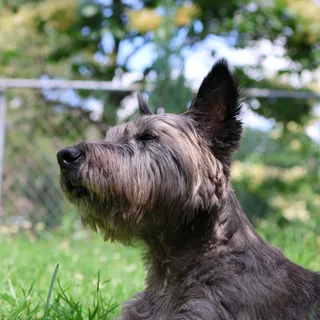
The Scottish Terrier is a small, stocky, powerful and agile dog, recognizable by its low-to-the-ground silhouette, its short and muscular back and its well let-down chest. Its head is long, with an almost flat skull, dark brown almond-shaped eyes, fine ears carried erect and a medium-length tail carried well up. Its coat consists of a harsh and dense outer coat combined with a soft undercoat, with pronounced furnishings on the muzzle, eyebrows and on the limbs. The most common colors are black, wheaten and brindle.
Temperament
Temperament and personality
Proud, loyal and very intelligent, the Scottish Terrier is a dog with character. It is more reserved than demonstrative, but it is attached to its family and knows how to be affectionate in its own way. Independent, courageous and lively, it keeps the terrier spirit with a certain tenacity and a true sense of alertness. It is normally not aggressive and often prefers to ignore strangers rather than seek conflict.
Living together
Living with children and animals
On a daily basis, the Scottish Terrier is calm at home if its need to go out is respected. It tolerates absences fairly well thanks to its independent side and adapts as well to life in the city as in the countryside. It enjoys regular walks, games with its loved ones and retains a hunting instinct that can lead it to follow a trail or take an interest in small animals. Its relationship with other animals therefore requires careful introductions and early socialization.
Training
Training and socialization
The education of the Scottish Terrier must be consistent, calm and firm, without harshness. Its intelligence allows it to learn, but its assertive and sometimes stubborn temperament requires working on motivation, repetition and regularity. Early socialization, clear rules and a well-maintained recall are essential to channel its independence and obtain a dog that is pleasant to live with.
Budget
Scottish Terrier price & budget
The price of a Scottish Terrier varies mainly depending on the seriousness of the breeding, the selection of breeding dogs, the quality of the lineage and the socialization work carried out before the puppy leaves. This breed also requires planning a maintenance budget consistent with its grooming and its health monitoring.
View cost breakdownHealth
Health at a glance
The Scottish Terrier is a small dog that looks hardy, but the breed requires real health monitoring. It tolerates cold and bad weather well thanks to its protective coat, but it has predispositions to certain hereditary or dermatological conditions that justify regular veterinary follow-up.
Prevention & watch pointsDiet
Feed it well
The Scottish Terrier must receive a complete, high-quality diet, adapted to its age, its weight and its activity level. In this breed, nutrition plays a central role, because excess energy quickly promotes overweight.
Our feeding adviceDid you know?
Anecdotes and popularity
Nicknamed Scottie, the Scottish Terrier has made canine history with its immediately recognizable silhouette. It also gained notoriety in the 20th century thanks to famous dogs like Fala, the companion of American President Franklin D. Roosevelt. Its beard, its bushy eyebrows and its dignified look make it one of the easiest terriers to identify.